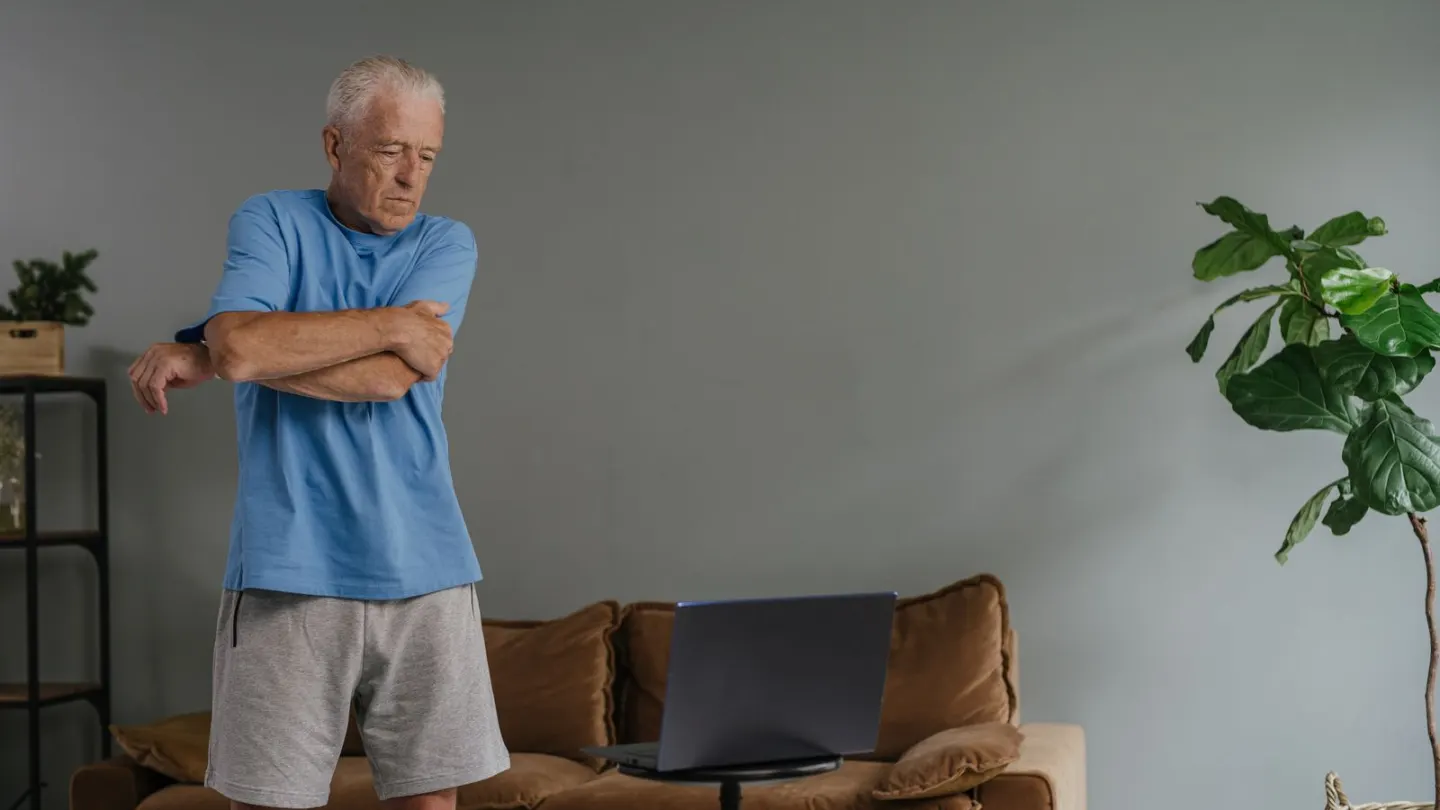
A home workout for sensitive shoulders should keep the elbows closer to the ribs and skip painful overhead presses. Gentle movement still counts.
Shoulder pain is common. The NHS says you can often ease it yourself, and that it may take weeks, not days. A home workout for sensitive shoulders is a way to keep the pushing muscles working without a deep bench press or a bar over the head. The NHS also says to stay active and to move the joint gently. Full rest in a sling is rarely the first plan unless a clinician has said so.
Adult activity guides in the UK and US still ask for muscle work on at least two days a week. Wall presses, floor presses, and band rows can meet that target. You do not need an overhead contest in the spare room.
Why pushing can hurt, and what to change
The shoulder is the most mobile joint in the body. That freedom is useful for reaching a high shelf. It is also why a sloppy press loads the wrong tissues. A wide press-up with elbows flared can feel sharp at the front of the joint. A bar behind the neck can feel worse.
The NHS lists tendon pain, bursitis, and a stiff “frozen” pattern among common causes. It also warns that shoulder pain with chest pain, breathlessness, or pain into the jaw can be a heart symptom. That is not a gym cue. That is emergency care: 999 in the UK, 911 in the US.
Most other shoulder aches are not an emergency. They still deserve a smaller range. Bring the hands to a wall. Shorten the press-up. Lie on the floor so the elbows cannot drop past the torso.
If you are building a first home habit, the four-week beginner bodyweight plan shows how to add sets slowly. Use the pushing swaps on this page when a full press-up still pinches.
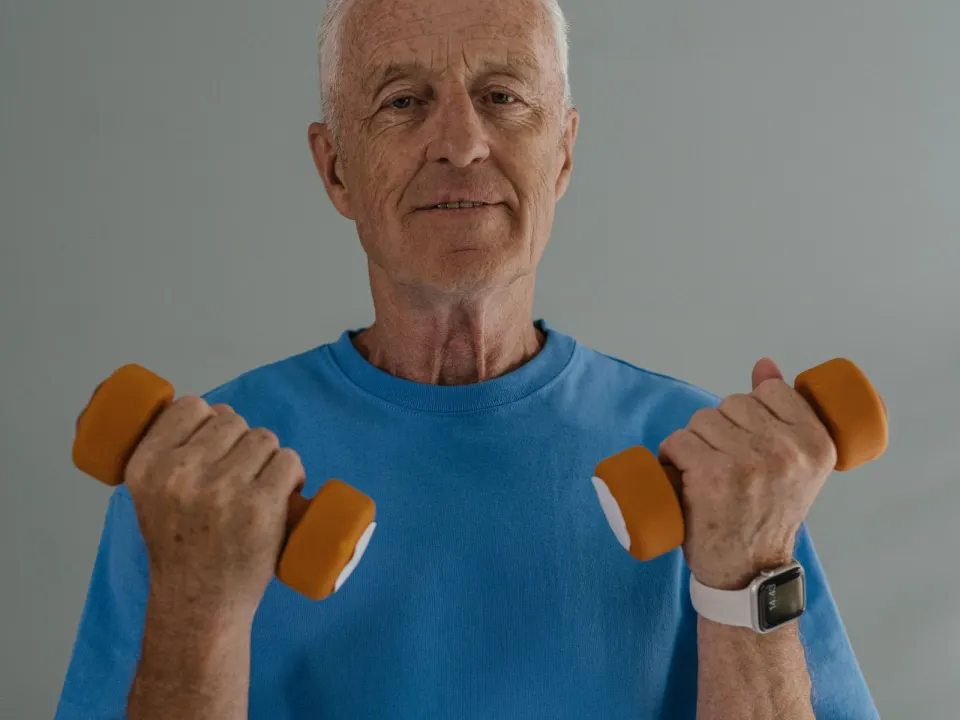
Set up a kind pushing station
Clear space in front of a blank wall. You need room to step back into a standing plank. A kitchen worktop is a second station if the wall feels too hard. A mat helps if you will later try a floor press.
Warm up for four minutes. Roll the shoulders in small circles. Reach one arm across the chest and hold without yanking. Open the chest in a doorframe for a gentle stretch. Stop if you feel a pinch at the top of the shoulder.
Stand tall. Drop the shoulders down, not up toward the ears. The NHS self-care pages suggest that simple posture change while you sit and stand. It is not a cure. It stops you starting every set in a shrug.
Keep the session quiet. No dropping weights. No clap press-ups. A quiet apartment workout pairs well with this block if you live above neighbours.

A sample home workout for sensitive shoulders
Do this home workout for sensitive shoulders twice a week. Leave a day between sessions. Match each push with a row so the front of the shoulder does not do all the work. Bands, a table row, or a backpack row all count.
| Push | Set-up | Start here |
|---|---|---|
| Wall press | Hands on the wall at chest height, slightly narrower than a wide press-up. Elbows point back, not out to the sides. Lower the chest toward the wall. Press away. | 2 to 3 sets of 8 to 12 |
| Worktop press-up | Same arm path on a sturdy kitchen edge. Keep the ribs down. Do not sag through the lower back. | 2 to 3 sets of 6 to 10 |
| Knee press-up | Hands under the shoulders on a mat. Knees down. Lower until the elbows make a comfortable angle, then press. | 2 sets of 5 to 8 |
| Floor press | Lie on your back with light bells or bottles. Press to straight arms. Lower until the elbows meet the floor. The floor stops a deep stretch. | 2 sets of 8 |
| Band pull-apart | Hold a light band at chest height. Pull the hands apart until the shoulder blades slide together. This balances the push. | 2 sets of 10 to 12 |
Pick one push and the band pull-apart. That is enough for a first month. When twelve wall presses feel easy, move to the worktop. Do not skip ahead because a video used full press-ups.
You can make the same wall press harder without raising the risk much. Slow the lower to three seconds. Pause a breath away from the wall. Add a set. Those tools sit with progressive overload without extra weight.
Adults over 50 who want easier floor transfers can use the supported options in our beginner home plan for over 50s. Getting up from the floor is part of a floor press. Skip that version if the transfer is the hard part.
Red flags and common mistakes
The NHS says to see a GP if shoulder pain is getting worse or has not improved after two weeks. Get urgent help if you cannot move the arm, if the joint has changed shape, if pins and needles will not go, or if the pain started after a fall. Severe pain in both shoulders, or feeling feverish, also needs prompt care.
Do not ignore pain that spreads to the chest, neck, or jaw, or that arrives with unusual breathlessness. That pattern is not “rotator cuff”. Use emergency services.
Common session faults are simple. The elbows flare like a T. The neck pokes forward. The lower back sags. The person holds their breath. Reset, then use a higher surface.
Behind-the-neck work, wide dips on chair arms, and kipping pull-ups are poor choices while the joint is grumpy. So is adding a heavy backpack to a press-up. Strength can wait for a calmer range.
Pushing options that often feel kinder
Prefer wall or high-incline press-ups, neutral-grip fist press-ups on a mat, and floor presses with light dumbbells or bottles if overhead work irritates. Dose: 3×6–10 in a range without pinch. Pair with band pull-aparts 3×12–15.
Positions to approach carefully
Wide-flare elbows, deep dips behind the torso, and forced overhead locks can aggravate sensitive shoulders. Keep elbows nearer ~45 degrees on presses and stop short of painful end range.
When to get assessed
Night pain, weakness lifting the arm, or symptoms after a fall deserve clinical advice. Training through progressive numbness or sharp catching is a poor plan.
| Label | Value | Unit |
|---|---|---|
| Wall press | 8-12 | reps |
| Worktop press-up | 6-10 | reps |
| Knee press-up | 5-8 | reps |
| Floor press | 8 | reps |
| Band pull-apart | 10-12 | reps |
Session notes specific to home workout sensitive shoulders
Before you repeat home workout sensitive shoulders, decide the exact surface, footwear and support object you will use. Write the first set’s intended reps or seconds on paper. After the session, record only what changed: a deeper controlled squat, a quieter footfall, a longer wall-sit, or a press-up incline that felt more stable. Those notes beat vague intentions to ‘train harder’.
If a joint feels sharper during home workout sensitive shoulders than muscularly tired, shrink range or choose the regression described earlier. Home training should leave you able to climb stairs and sleep that night. Seek GP or physiotherapy advice for pain that lingers, swells, or follows a fall.
Space hard versions of home workout sensitive shoulders so similar patterns are not hammered on back-to-back days. A walk, easy mobility, or an upper-body focus can fill the gap while tissues adapt.
A sample push day that stays mid-range
Warm-up: band pull-aparts 2×12, wall slides 8. Main: high-incline press-ups 3×6–8, light bottle floor press 3×8, scapular squeezes 2×10, doorway stretch 2×25 seconds/side. Skip behind-the-neck work and deep dips. Stop two reps before a pinch.
If a previously comfortable incline starts to pinch, raise the surface for a week. Shoulders often prefer patience over hero angles.
One more concrete week of practice
Schedule two appointments with yourself for the skills in this article. Session one copies the doses exactly. Session two adjusts a single cue that felt weakest — depth, quiet footfall, hold time, or screen height — and keeps everything else identical.
After those two sessions, keep what was sustainable. Discard any add-on that only worked once. That is enough experimentation for one week.
Coaching details that make home workout sensitive shoulders more repeatable
Treat home workout sensitive shoulders as a skill with measurable standards, not a vague intention to move more. Before the session, name the surface (mat, wall, stair, chair), the exact footwear, and the first prescribed dose from this article — for example a set count, a hold time, or a work/rest interval. If you cannot state the first dose in one sentence, skim the earlier sections again before you start the clock.
During the session, use a simple quality gate: the last two repetitions or the last ten seconds should still resemble the first. When they do not, end the set, rest, and resume with a smaller range, more support, or a slower tempo. That gate protects joints and teaches better motor control than grinding ugly reps to hit a round number.
After home workout sensitive shoulders, write three fields only: what you completed, one cue that helped (soft heel, ribs down, quiet landing, longer exhale), and next-morning joint notes if any. Keep the log in the same notebook or notes thread every time. Over a month, you should see either cleaner technique at the same dose or a small planned progression — more seconds, one extra set, a harder leverage — changed one at a time.
Regression ladder when form or comfort slips
- Shorten range — higher wall-sit, shallower squat, shorter dead-bug reach.
- Add support — chair back, wall fingertips, rail on stairs.
- Slow the tempo — three-second lowers beat bouncing out of the bottom.
- Cut volume — drop a set before you add impact or load.
- Swap the pattern — choose the easier variation already named in this article.
Use the ladder for a full week if needed, then retest the standard version of home workout sensitive shoulders. Regression is training, not failure. People who live in flats, share walls, or train around family schedules especially benefit from quiet, supported options that still load muscle.
Safety boundaries worth repeating
Stop for chest pain, faintness, unusual breathlessness, sudden swelling, or neurological symptoms such as progressive numbness or arm/leg weakness. Sharp joint pain that alters your walk the next day deserves clinical advice rather than another video progression. If you are pregnant, postpartum, post-operative, or living with a long-term condition that affects balance, bone health or heart rate response, ask a GP or physiotherapist (US: primary care clinician or physical therapist) how to adapt the doses here.
Place harder versions of home workout sensitive shoulders on non-consecutive days when the same tissues are the limiting factor. Fill gaps with walking or an upper/lower emphasis that does not repeat the same stress. Consistency across weeks matters more than matching a stranger’s circuit density.
Frequently asked questions
Should I stop all pressing if my shoulder aches?
Are press-ups safe with sensitive shoulders?
Can I lift my arms overhead?
How long does shoulder pain take to settle?
Do I need a resistance band?
Sources
- 1. Shoulder pain
- 2. Physical activity guidelines for adults aged 19 to 64
- 3. Adult Activity: An Overview
- 4. Shoulder Injuries and Disorders
- 5. Physical Activity Guidelines
Guidance changes. Figures were checked against the sources above at the time of review; always confirm current advice with your GP, pharmacist or clinician.
Image credits
- Photo: Photo by SHVETS production on Pexels / Openverse
Was this useful?
Anyone can react — no account needed.



Discussion
0 comments · Name and email only · Email is never shown