Sleep & Recovery Science explainer
Snoring Apps Are Not Sleep-Apnoea Tests: What They Can and Cannot Show
Updated
Snoring app sleep apnea limits start with a simple fact. A bedside phone records noise. A sleep study measures airflow, effort, and often oxygen. This is a source-reviewed guide, not a hands-on lab test.
Partners hear snoring. Apps turn that noise into a graph. The jump from “loud night” to “I have sleep apnoea” is the error this page exists to stop.
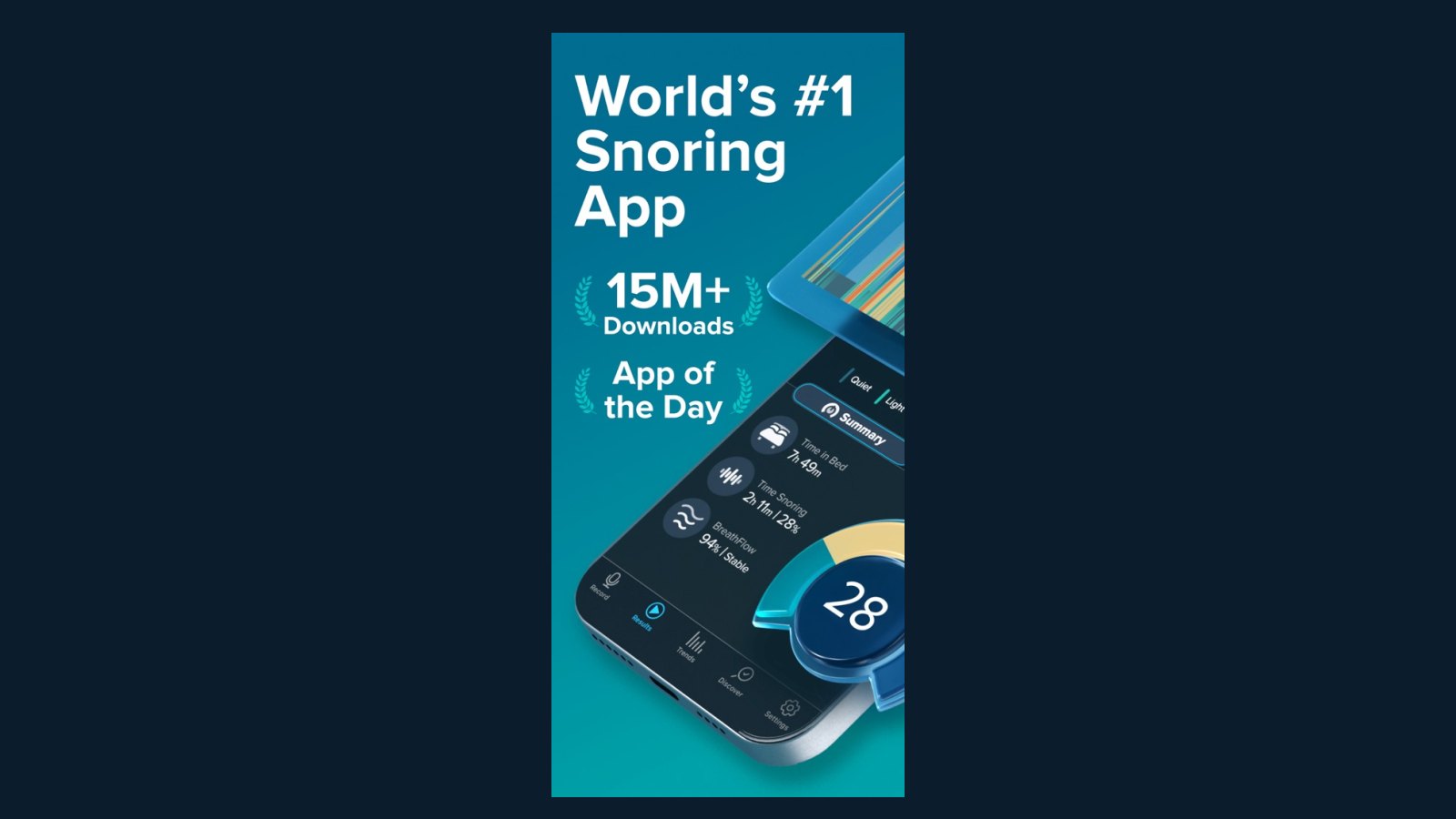
Product write-ups of SnoreLab, SleepScore, and Sleep as Android stay on features and prices. They are not a clinic report. The best sleep trackers hub is the same: a shopping shortlist, not a test.
What a snoring app can actually record
Most consumer apps listen with the phone microphone. Some add an accelerometer. A few research tools pair the phone with a finger oximeter. Those are different instruments. They should not share one accuracy claim.
A useful recording can show how often you snore, how loud the peaks are, and whether a gasp sits after a quiet gap. That can help a partner who already hears the noise. It can help you show a GP a clip. It does not measure an apnoea–hypopnoea index.
An apnoea is a pause in breathing, not a decibel. NICE and NHS pages define severity with AHI from a sleep study: 5–14 mild, 15–30 moderate, over 30 severe. A snore score is not that scale.
Snoring app sleep apnea limits in clinic guidance
NHS advice, captured 13 September 2026, says see a GP if breathing stops, if you gasp or choke, or if you are very sleepy by day. Testing is a clinic-issued monitor, usually at home, sometimes overnight in a lab.
NICE guideline NG202 (published 20 August 2021) tells clinicians to offer home respiratory polygraphy for suspected OSAHS in people over 16. If that is scarce, consider home oximetry, then step up if symptoms stay strong. Consumer app stores are not in that pathway.
The American Academy of Sleep Medicine’s 2018 position statement is blunt. Consumer sleep technologies that lack FDA clearance cannot be used to diagnose or treat sleep disorders. They may support a conversation. They do not close the case.
| Question or claim | Evidence source | Study type | Population | Reference standard | Outcome | Key finding | Limitation | Applicability |
|---|---|---|---|---|---|---|---|---|
| A smartphone can replace PSG for moderate-to-severe OSA | Kim, Kim and Hwang, PLoS ONE, 2022 | Systematic review and meta-analysis | 11 studies; 1,644 participants | Polysomnography, AHI above 15 | Sensitivity, specificity, AHI difference | Pooled sensitivity 0.91; specificity 0.88; AUC 0.92. Mean AHI difference about −0.7 with wide limits of agreement | Heterogeneous sensors; few studies; not one store brand | Research phones and add-ons, not a random App Store download |
| Sound-only screening matches motion or oximetry | Same 2022 meta-analysis, subgroup by sensor | Subgroup analysis | Mixed clinic samples | PSG | Diagnostic odds ratio | Motion and oximetry subgroups had higher diagnostic odds than sound-only methods | Some subgroups were one study | A microphone app is the weaker design in that paper |
| A snoring app can screen a quiet, non-symptomatic public | Grossauer et al., Journal of Clinical Medicine, 2024 (ESOSA; Snorefox M) | Diagnostic study vs Type-II home PSG | 150 adults; 142 valid nights; people with classic OSA symptoms were excluded | PSG, AHI at least 15 | Sensitivity, specificity, PPV, NPV | Sensitivity 0.91; specificity 0.83; PPV 0.63; NPV 0.97. About 24% still had moderate-to-severe OSA on PSG | One named research app; one night; funded screening context | A “clear” night does not rule out every case. A “flag” is not a diagnosis |
| SnoreLab can diagnose OSA from a Snore Score | SnoreLab Insights and Terms, captured 13 September 2026 | Manufacturer policy, not a trial | Consumers | None | Claim language | The company says it is not an automatic detector and not a medical device. Apnoea needs airflow and effort, not sound alone | Marketing pages can still sound clinical | Treat the app as a recorder |
| NICE accepts consumer snoring apps as the first diagnostic test | NICE NG202, 2021 | Clinical guideline | Adults over 16 with suspected OSAHS | Home respiratory polygraphy | Recommended test | Home polygraphy is the offered test. Oximetry is a fallback. Apps are not listed | Guideline age; devices evolve | UK clinic pathway |
Why a loud night is not an AHI
Primary snoring is noisy airflow. Obstructive apnoea is a blocked airway with a breathing pause. Many people who snore do not have OSA. Almost all people with OSA snore. That overlap fools both households and algorithms.
SnoreLab’s own explainer is useful here. The firm says some users find gasp-like clips and take them to a doctor. It also says some people with diagnosed OSA have low Snore Scores, because a pause can be quiet. That is a core snoring app sleep apnea limits point. Silence can be the problem.
Kim’s 2022 review said the average AHI from phones sat close to PSG, but the spread was wide. A single night can look “near the truth” and still be a poor number for one person. The authors asked clinicians to be cautious.
What research phones measured that store apps often do not
The better-looking papers did not rely on a free snore timer. Several used extra hardware: a pulse oximeter, a chest sensor, or a locked research build. The 2022 meta-analysis split methods. Motion or oximetry tended to beat sound alone on specificity and diagnostic odds.
A 2025 Sleep and Breathing proof-of-concept for the research app Apneal (46 adults, one French centre) compared phone sound and motion with PSG. Manual scoring looked closer than the early automatic model. That is a lab prototype, not the icon on a supermarket phone.
Baptista and colleagues reviewed consumer sleep-breathing apps in 2022. Their conclusion, as summarised in later clinical write-ups, was that most store apps lack the validation a clinic would need. We treat named shop apps as unverified unless a paper names that exact build.
How to use a recording without over-reading it
If you already snore, a week of recordings can show whether alcohol, a cold, or back-sleeping made the night louder. That is behaviour data. It is not a severity grade.
If you gasp, choke, stop breathing, or nod off while driving, skip the app debate. NHS copy says see a GP. Bring the clip if you have one. Ask for the clinic test the guideline already names.
If you sleep alone, a recording can be the first witness. It still cannot measure oxygen. It cannot sort central from obstructive events. It cannot clear you after one quiet file.
Short sleep also changes next-day hunger. That is a separate problem. See sleep and weight regulation for the appetite side, not for an apnoea label.
What remains unverified for shop apps
We did not find an independent, branded PSG trial of SnoreLab, Sleep as Android, or Pzizz that reports AHI agreement in a clinic sample. If a later paper names those builds, it should be read on its own methods, not copied onto every snore app.
Store stars measure liking. They do not measure AHI. Privacy labels tell you what may be uploaded. They do not tell you if your airway closed.
Until a named consumer app sits in a registered diagnostic study against polygraphy or PSG, the fair sentence is short. Snoring app sleep apnea limits are the product. The recording is a note. The test is still a sleep study.
Frequently asked questions
Can a snoring app diagnose sleep apnoea?
Why do some papers look accurate then?
If my app says I am low risk, can I skip the GP?
What should I take to a GP?
Is a high Snore Score the same as a high AHI?
Can I use an app to track CPAP?
Sources
- 1. Sleep apnoea
- 2. Obstructive sleep apnoea/hypopnoea syndrome and obesity hypoventilation syndrome in over 16s (NG202)
- 3. Diagnostic value of smartphone in obstructive sleep apnea syndrome: a systematic review and meta-analysis
- 4. Evaluation of an OSA risk screening smartphone app in a general, non-symptomatic population sample (ESOSA)
- 5. Is it snoring or sleep apnea?
- 6. Consumer sleep technology: an American Academy of Sleep Medicine position statement
Guidance changes. Figures were checked against the sources above at the time of review; always confirm current advice with your GP, pharmacist or clinician.
Image credits
- Photo: Photo by Pixabay on Pexels / Openverse
- Photo: Photo by Jean van der Meulen on Pexels / Openverse
- Photo: Photo by Naro K on Pexels / Openverse
- Photo: Photo by Pexels contributor on Pexels / Openverse
- Photo: Photo by Italo Melo on Pexels / Openverse
Was this useful?
Anyone can react — no account needed.
Discussion
0 comments · Name and email only · Email is never shown