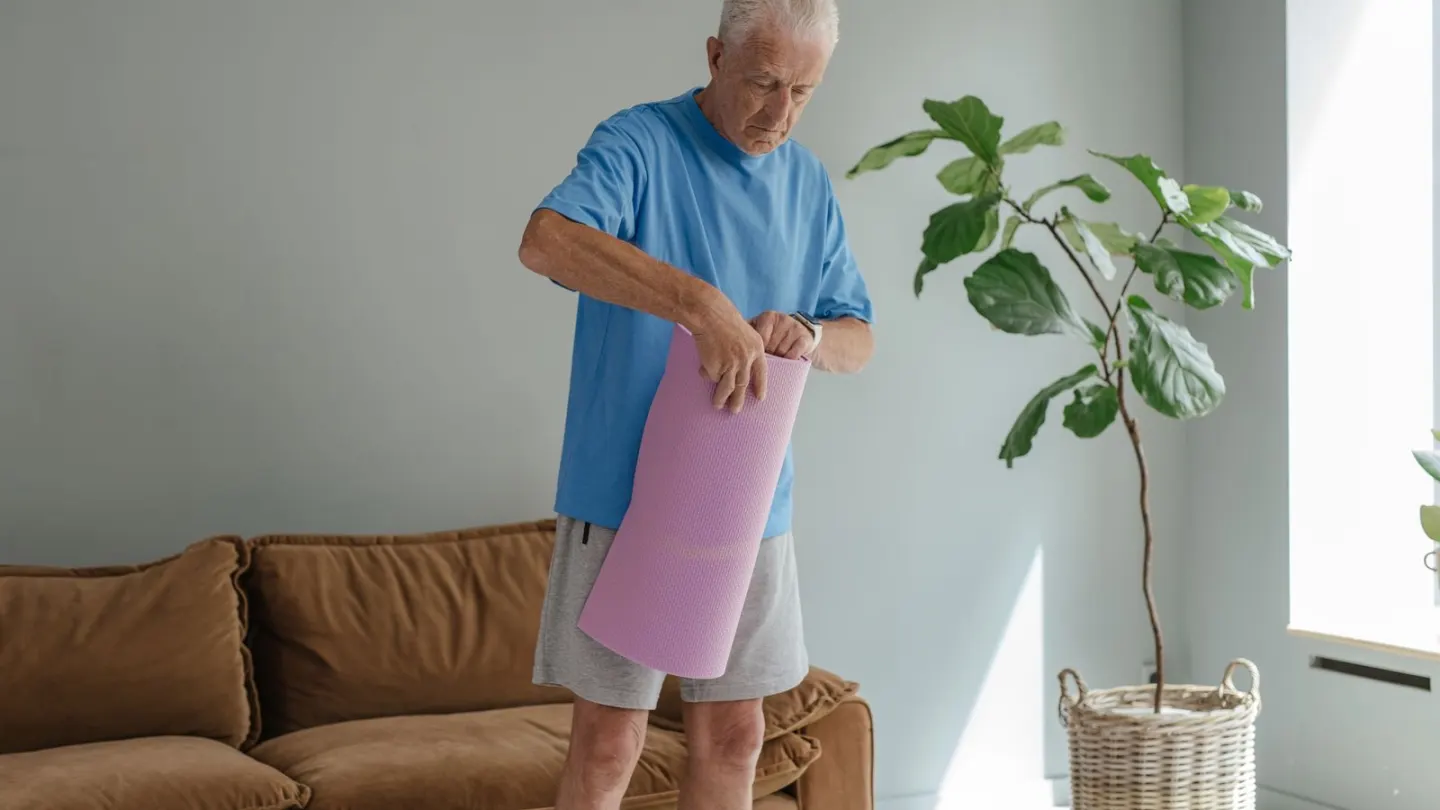
A goblet squat is a squat with a kettlebell or dumbbell held at the chest, like a cup. The load stays close. The torso stays tall. It is a beginner-friendly way to practise the sit-and-stand pattern with a little extra weight.
You do not need a barbell on your back. You hold the horns of a kettlebell, or one end of a dumbbell, under the chin. Elbows point down. Then you sit the hips back and down, and stand by pushing the floor away.
NHS and CDC adult guides still want muscle-strengthening work on at least two days a week. A goblet squat can be the leg piece of that week. It is not a contest depth. It is a repeatable sit you can control.
Why a goblet squat suits beginners
A back squat asks you to balance a bar. A goblet squat puts the mass in front, where you can see it. Many people find it easier to keep the chest up. The elbows can also cue the knees not to cave in.
The pattern still trains the thighs, hips and the muscles that keep you upright. NHS strength pages already include a bodyweight squat. Adding a kettlebell is a small next step, not a new sport.
UK and US activity guides treat this as strength, not as a calorie trick. The CDC pairs two days of muscle work with at least 150 minutes of moderate aerobic activity. WHO uses the same 150-minute aerobic floor. Pair the squat with a push, a pull and a walk so the week is not all legs.
If you are over 50 or returning after a long gap, the strength training over 50 guide is a calmer on-ramp. Use a lighter bell. Shorten the depth. Hold a rack for balance if you need it.
How to set up a goblet squat
Pick a kettlebell you can park at the chest without a shake. A dumbbell stood on end works if that is what the gym has. Hold it by the horns, or cup the top of the dumbbell. Pull it into the breastbone. Do not let it drift away.
Stand with the feet about hip to shoulder width. Toes can turn out a little. Brace the midriff as if someone might poke it. Sit the hips back and down. Keep the heels heavy. Let the knees follow the toes. Pause when the thighs are as low as you can control. Stand by pushing the floor away. Do not bounce.
Depth is personal. Many people feel fine near parallel with the floor. Others need a higher sit, especially if the ankles are stiff. A pain-free range you can repeat is more useful than a deep squat you cannot own.
Film a side view on a phone if you like. The chest should stay fairly tall. The weight should stay close. If the heels pop up, shorten the depth or take some load out.
A simple goblet squat session
Warm up for five minutes. Walk, circle the hips, and do eight empty sit-to-stands from a bench. Then rehearse two slow goblet squat reps with the lightest bell. Only then start the working sets.
ACSM treats regular resistance work as the useful health step. Sets of about 8 to 12 reps suit many healthy adults. Leave two reps in reserve. Our RPE and RIR guide explains that buffer in plain language.
| Item | First weeks | Once the squat is smooth |
|---|---|---|
| Load | A bell you can hold still at the chest | A bell you can still control for 8 tidy reps |
| Sets | 2 | 3 |
| Reps per set | 8 to 10 | 8 to 12 |
| Rest between sets | 90 seconds | 60 to 120 seconds |
| Days each week | 2, not back to back | 2, still not back to back |
| If it feels light | Add 2 slow reps | Use the next bell, then drop back to 8 reps |
| If it feels heavy | Stop at 6 clean reps | Use a lighter bell or squat to a box |
Place the goblet squat near the start of a lower-body block, while you are fresh. A beginner gym workout plan can fill the other slots with a press, a row and a hinge. Do not add jump squats on the same day if this pattern is new.
Write the bell number and the reps in a notebook. When 12 reps feel boring, take the next kettlebell and return to eight. That is progressive overload in a small step. Change one thing at a time. A goblet squat session should finish in about ten minutes of work, plus rest. That is enough for most weeks. You do not need a 40-minute squat block.
Common faults and kinder swaps
Knees that dive inward often mean the load is too heavy. Take weight out. Think of spreading the floor with the feet. Elbows that flare can let the bell drift. Pull it back to the chest.
A rounded upper back can mean the bell is too heavy or the sit is too deep. Stand tall before you descend. Do not chase depth for a camera.
Heels that lift often mean the ankles want a shorter range. A 2.5 kg plate under each heel is a coaching trick some gyms use. A box squat to a high bench is a fair swap. So is a sit-to-stand with no bell.
Do not bounce out of the bottom. Do not catch your breath by clamping it. Breathe out as you stand if that helps you keep a steady face.
Who should skip or adapt the goblet squat
If you have been told to limit squatting after surgery, wait for personal advice. The same applies during late pregnancy, or if a knee swells, locks, or gives way. A higher box squat is a fair substitute.
Stop for chest pain, faintness, unusual breathlessness, or pain that shoots down a leg. Call 999 in the UK or 911 in the US if those symptoms are sudden. Online cues cannot replace an exam.
A goblet squat is not a treatment for knee or back pain. Choose a depth you can repeat without sharp pain. A trainer or physiotherapist (US: physical therapist) can watch you if the pattern still feels unsafe.
A goblet squat progression from learning loads to working sets
Hold a dumbbell or kettlebell at the chest with elbows pointing down. Feet about shoulder width. Example session: goblet squat 4×8 at RPE 7–8 with two minutes rest, then split squat 2×8/leg, then a hinge 3×8. Film a side set to confirm depth.
Cue: brace lightly, sit between the hips, keep heels down, and stand without collapsing the chest onto the bell.
When 12 clean reps feel easy, raise the load 2–4 kg rather than chasing thirty endless reps every set.
| Stage | Sets × reps | Intent |
|---|---|---|
| Learn | 3 × 6–8 light | Depth & brace |
| Build | 4 × 8 | Progress load |
| Volume | 3 × 10–12 | Hypertrophy |
| Swap later | Front squat / back squat | When ready |
Form faults and kinder swaps
Heels rising: shorten depth slightly or elevate heels a little while you work on ankle range — or swap to a box squat target.
Torso collapsing onto the bell: lighten load and think “chest tall, elbows to ribs”.
Knees diving in: push the floor apart and reduce load until tracking improves.
Goblet squats as a teaching tool toward a barbell
When goblets are solid at challenging loads, try a light front squat or safety-bar squat while keeping goblets as a warm-up.
Do not rush to a back squat if the torso still collapses — ownership first.
Home trainees can stay on goblets for years and still meet strength-guideline frequency.
Who should skip or adapt goblet squats
People with acute knee or hip pain should not push through sharp symptoms; try sit-to-stands to a chair height that stays comfortable and seek advice if pain lasts.
Those who cannot hold the bell comfortably can use a front-loaded bag or a counterbalance plate.
Pregnant lifters should follow maternity guidance on breath-holding and depth.
Coaching cues and checkpoints for goblet squat technique
Return to the key prescriptions for goblet squat technique already set out above and execute them as written for two consecutive sessions before you invent variations.
Use the checkpoints below as a quick pre-set scan for goblet squat technique. If any line fails, fix that line before you add load, speed or volume.
- Learn: 3 × 6–8 light — Depth & brace
- Build: 4 × 8 — Progress load
- Volume: 3 × 10–12 — Hypertrophy
- Swap later: Front squat / back squat — When ready
After those two honest sessions, change only one variable in goblet squat technique: a small load jump, one extra repeat, a slightly longer interval, or one fewer accessory set. Write the change in the log before you warm up.
Stop for sharp pain, chest pain, faintness or unusual breathlessness. Call 999 or 911 for sudden severe symptoms. This article is general information, not a diagnosis or a personalised rehab plan.
Frequently asked questions
Is a goblet squat better than a back squat?
Kettlebell or dumbbell for a goblet squat?
How heavy should I go?
Do I need to squat below parallel?
Can I goblet squat every day?
Sources
- 1. Physical activity guidelines for adults aged 19 to 64
- 2. Strength exercises
- 3. Adult Activity: An Overview
- 4. Physical activity fact sheet
- 5. Physical Activity Guidelines
- 6. Why you should do strength training
Guidance changes. Figures were checked against the sources above at the time of review; always confirm current advice with your GP, pharmacist or clinician.
Image credits
- Photo: Photo by SHVETS production on Pexels / Openverse
- Photo: Photo by Victor Freitas on Pexels / Openverse
- Photo: Photo by Scott Webb on Pexels / Openverse
Was this useful?
Anyone can react — no account needed.



Discussion
0 comments · Name and email only · Email is never shown