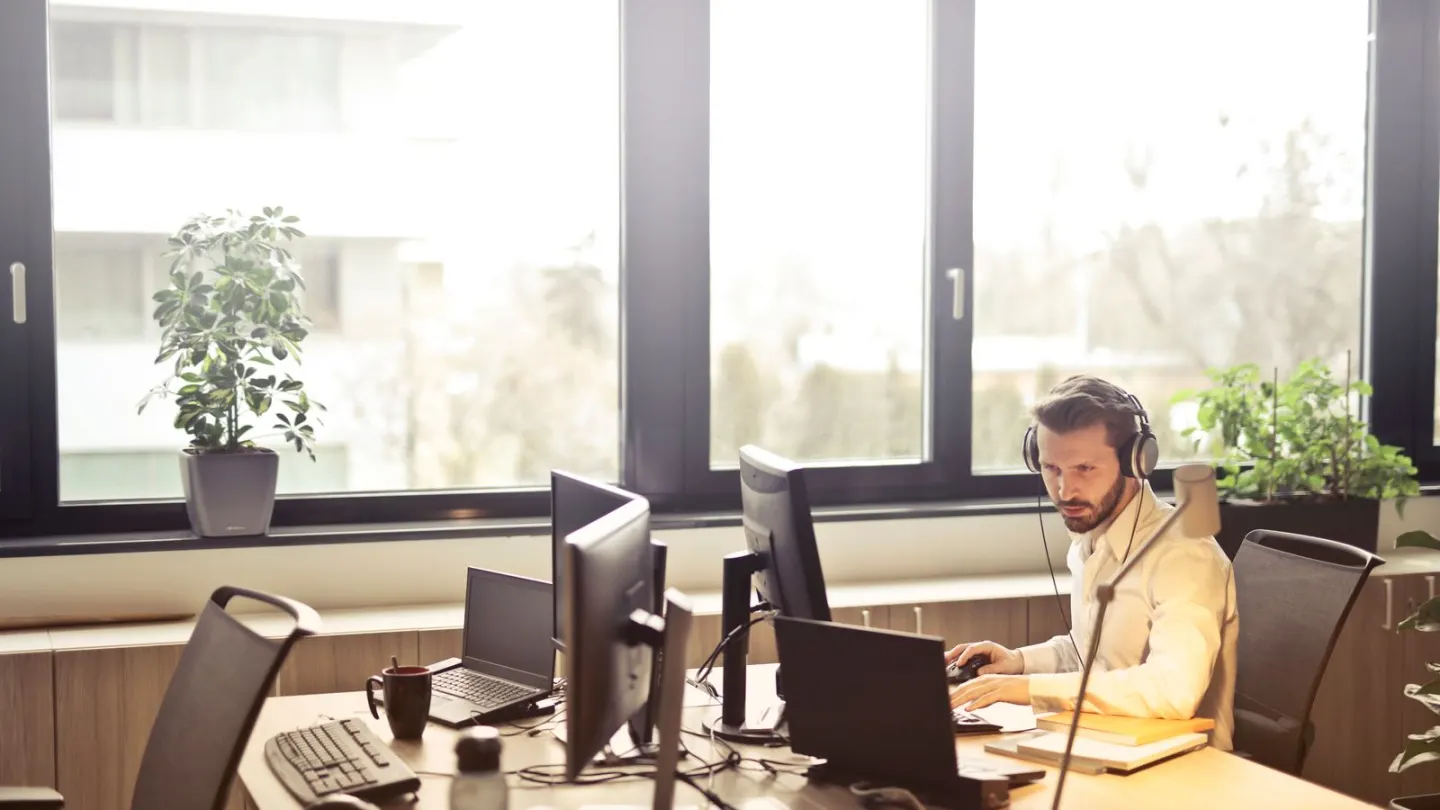
Chat, printers and a neighbour’s call can wreck deep work. Loud headphones can then create a new hearing risk.
If open office noise focus keeps slipping, the room is often the cause, not a weak will. Speech is uniquely sticky. Your brain follows a half-heard name even when you try to ignore it. That is tiring. It is not the same problem as factory noise that can damage hearing. Typical office talk sits well below occupational limits. The cost is attention, stress, and the urge to crank volume in your ears.
The useful tools are quiet rooms, short walks, and headphones used at a safe level. WHO safe-listening advice is blunt: keep device volume down, prefer well-fitted cups that block some room sound, and watch weekly dose. A playlist is not a licence to sit at 90% all afternoon.
What open office noise focus actually costs you
Open floors trade cheap desks for leaked speech. You hear half sentences. You wait for your name. You restart the same paragraph. That load is real even when a sound-level app would not flash a hazard. NIOSH sets a recommended occupational limit of 85 dBA averaged over eight hours to protect hearing. Most office conversation lives far under that line.
HSE’s noise rules in Great Britain target work that can damage hearing or hide warning sounds. A busy sales floor can still feel chaotic without meeting those action values. Treat the open office as an attention design problem first. Treat hearing protection as the wrong tool for ordinary chat, unless a survey shows true hazardous noise.
The body still pays. Shoulders creep up. You type harder. You skip the walk because putting the headset down feels like losing a shield. That is how noise leaks into posture. The desk ergonomics checklist still applies. A perfect chair cannot filter a loud neighbour.

Headphones, volume and a weekly sound dose
Headphones help when they let you work at a lower level, not a higher one. WHO’s safe-listening Q&A says you can listen at about 80 dBA for up to 40 hours a week. Turn the level up, and safe time shrinks fast. A simple public tip is to stay near 60% of the device maximum. Use well-fitted, noise-cancelling cups so you do not fight the room with extra volume.
In-ear buds that leak force you to turn up. Over-ear cups with a seal often win in an open office. They are still personal audio devices. They still count toward weekly dose if the track is loud. White noise and rain sounds can mask speech at a lower level than a bass-heavy playlist. That is the point. Mask the words. Do not stage a concert.
Take the cups off on the walk to water. WHO notes that duration matters, not only the peak. A playlist that runs from 9 to 5 is still a long dose. Build gaps.
| Tactic | What it helps | How to use it | Watch-out |
|---|---|---|---|
| Quiet room or booth | Deep work without leaked speech | Book 60 to 90 minutes for writing or analysis | Do not hide there all day; you still need movement |
| Noise-cancelling headphones | Lower volume for the same mask | Keep device volume near 60% of maximum | You may miss alarms or a colleague at your shoulder |
| Soft mask sound | Speech that is less sticky | Rain, fan, or brown noise at a low level | Bass-heavy music tempts a louder setting |
| Walk or corridor loop | A true change of sound and posture | Five to ten minutes each hour or two | Phone scrolling on the walk is still near work |
| Earplugs | Very loud rooms or travel | Use when a survey shows hazardous noise | Wrong tool for ordinary chat; can over-protect |
Breaks, walks and a quieter hour
Protect one deep-work block if your job allows it. Morning is often easier. Put it on the calendar as a meeting with a room. Headphones then become a backup, not the whole plan. HSE display-screen guidance still wants changes of activity. A silent booth that you never leave is just another still posture.
Between noisy spells, walk. A corridor loop resets the ears and the hips. Pair it with the short bouts in our movement snacks for the work day guide. If shoulders lock while you hunch toward a call, two minutes from the ten desk stretches is a better restart than a louder track.
Lunch away from the floor helps more than a sandwich under the cups. Eat where speech is not your problem.

Talk to the room, not only your playlist
Some noise is a manners issue. Agree on phone booths for long calls. If your work needs quiet for accuracy, raise it as a work-pattern issue. In Britain that can sit with DSE breaks. In the US, facilities or occupational-health contacts can log a survey.
Do not shame people who need a booth. Hearing differences, migraine, and anxiety can make leaked speech heavier. A quieter seat is a reasonable adjustment. If you hot-desk, wrists still need a fair setup. See the keyboard and mouse RSI guide after you book the quieter hour.
When sound problems need a clinician
Sudden hearing loss in one ear is urgent. So is hearing loss with weakness on one side of the face, a severe spinning attack, or a new severe headache. In the UK call 999 or go to A&E for those clusters. In the US call 911. Persistent ringing, muffled hearing after loud leisure noise, or pain in the canal needs a GP, audiology, or urgent care depending on severity.
NHS hearing-loss pages note many causes: wax, infection, age, and noise. Do not assume the open office is the culprit. Get wax checked before you buy stronger buds. A playlist is not treatment for panic or lost sleep.
A simple day plan you can keep
Start the first 90 minutes in the quietest seat you can book. Keep volume low. Walk five minutes with the cups off. Do collaborative work when speech is expected. If you cannot book a room, face a wall, use a soft mask sound, and defend two short walks. That beats eight hours of leaked speech plus a loud mix.
Noise strategies that protect focus and hearing
Try a stack: polite norms (headphone signals), noise-cancelling or gentle pink-noise audio at moderate volume, booked quiet rooms for deep work, and outdoor walks between noisy blocks. Keep headphone volume moderate; loud noise-cancelling listening for hours is still hard on ears.
Break design in open offices
Take microbreaks away from your desk so your brain gets a spatial change, not only a tab change. A three-minute stairwell or outdoor reset can help more than scrolling chat with headphones on.
When noise is a health issue
If noise levels regularly prevent work or raise stress sharply, raise it with managers or occupational health. Individual coping has limits in poorly designed spaces.
Workday application notes for open office noise focus
Tie open office noise focus to a visible cue you already have: a kettle boil, the end of a recurring meeting, or plugging in a laptop at the start of deep work. Keep a one-line prompt on a sticky note near the screen with the first move and hold time so you do not renegotiate the routine mid-afternoon.
If symptoms during open office noise focus include numbness, progressive weakness, chest pain, or pain that wakes you at night, stop self-managing and speak with a clinician or occupational-health service. Comfort drills support ordinary stiffness; they do not replace assessment.
Revisit your desk height, screen position and break timing whenever you change chairs, monitors or work locations. A routine built for one setup can feel oddly hard in another — adjust the environment before you assume you need more aggressive stretching.
Practical checkpoints for open office noise focus
Rehearse the main drills for open office noise focus at the exact doses already listed. Change only one variable this week — range, tempo, or support — and write down the result the next morning.
Keep safety limits visible: sharp pain, dizziness, chest symptoms, or neurological changes mean stop and seek care. Modest consistency with open office noise focus beats sporadic intensity.
If your environment changed (new chair, different floor, travel), re-check setup before blaming the programme. Small environment fixes often restore comfortable technique faster than adding volume.
One more concrete week of practice
Schedule two appointments with yourself for the skills in this article. Session one copies the doses exactly. Session two adjusts a single cue that felt weakest — depth, quiet footfall, hold time, or screen height — and keeps everything else identical.
After those two sessions, keep what was sustainable. Discard any add-on that only worked once. That is enough experimentation for one week.
Frequently asked questions
Is open-office chat loud enough to damage hearing?
Are noise-cancelling headphones safe to wear all day?
Should I play music or white noise?
What if my job will not allow a quiet room?
When should I get my hearing checked?
Sources
- 1. Noise-induced hearing loss
- 2. Understand noise exposure
- 3. Deafness and hearing loss: safe listening
- 4. Making listening safe
- 5. Noise at work
- 6. Hearing loss
Guidance changes. Figures were checked against the sources above at the time of review; always confirm current advice with your GP, pharmacist or clinician.
Image credits
- Photo: Photo by Andrea Piacquadio on Pexels / Openverse
- Photo: Photo by fauxels on Pexels / Openverse
Was this useful?
Anyone can react — no account needed.




Discussion
0 comments · Name and email only · Email is never shown