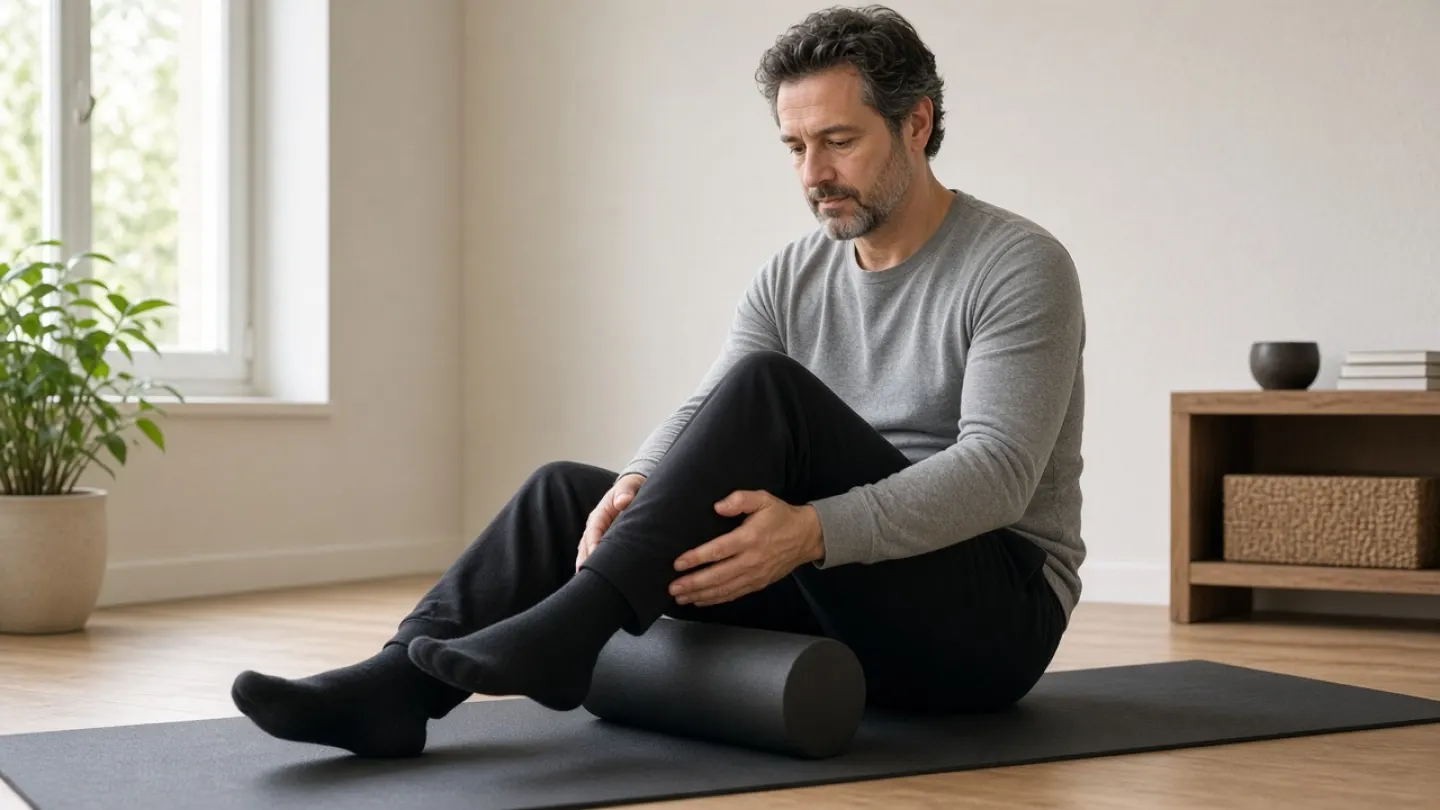
Stretching app evidence is mostly about showing up, not about magic range. A phone can time a hold and play a video. It cannot replace a trial of that exact brand. This is a source-reviewed guide, not a hands-on lab test.
App stores sell flexibility the way supplement shops sell energy. The mechanism is ordinary: you move, you repeat, tissue and nervous system adapt a little. The extra claim is that the interface makes you do it.
That extra claim is testable. Few consumer stretch apps have sat in those tests. This page separates stretching science from stretching app evidence. Product write-ups of Flexor, Pliability, Bend, StretchIt, and GOWOD stay in the best stretching apps family. They are not proof.
What a stretching app can plausibly change
A decent app offers a timer, a demonstration, and a reminder. Those are behaviour tools. Digital-health papers often find better logging and higher satisfaction when a video replaces a paper sheet.
Range of motion still depends on the work. Konrad’s 2023 meta-analysis of stretch training (77 studies) found a moderate ROM gain versus controls in healthy people. Static and PNF methods beat ballistic or dynamic work for long-term range. That literature is mostly supervised or lab-based. It is not an App Store category review.
If an app only reminds you to hold a calf stretch, it can ride that older evidence. If it promises splits in 30 days or a unique “mobility score,” that is a new claim. New claims need new trials.
The small trial that actually used a stretching application
Park and colleagues published a randomised trial in Applied Sciences in 2024. Thirty-four volunteers did four calf stretches and two hamstring stretches for four weeks. Half used a custom application with videos and optional alarms. Half used a non-digital version.
Within the app group, several flexibility and balance scores improved, except dorsiflexion range. Between groups, the standout differences were satisfaction and adherence. The app group logged more sessions (8.0 versus 5.18 across 28 days) and scored higher on a 10-item satisfaction survey (41.18 versus 36.88). Left straight-leg raise improved more in the app group. Other between-group flexibility contrasts were not consistent.
The authors said the study was short, voluntary, and used a homemade satisfaction scale. People still skipped days. Twice-weekly participation in the app arm was common. That is useful stretching app evidence for adherence. It is not a validation of any commercial brand.
| Question or claim | Source | Study type | Population | Comparator | Outcome | Key finding | Limitation | Applicability |
|---|---|---|---|---|---|---|---|---|
| A stretching app improves flexibility more than the same moves on paper | Park et al., Applied Sciences, 2024 | RCT, 4 weeks | 34 healthy volunteers (17 vs 17) | Same stretches without the app | ROM, sit-and-reach, SLR, Y-balance, satisfaction, adherence | App users were more satisfied and logged more days; left SLR change favoured the app; many flexibility contrasts were not between-group | Tiny sample; 4 weeks; custom app, not a store brand | Healthy adults, lower-leg stretches only |
| A phone programme beats a standard home plan for frozen shoulder | Choi et al., Clinical Rehabilitation, 2019 | RCT, 12 weeks | 84 patients (42 vs 42) with frozen shoulder | Conventional self-exercise | Pain VAS and passive shoulder ROM | Both groups improved over time; no significant difference between groups | Single centre; condition-specific | Do not assume an app wins in clinical shoulder rehab |
| Stretch training raises ROM in healthy people | Konrad et al., J Sport Health Sci, 2023 | Meta-analysis, 77 studies | Healthy participants | Non-stretch controls | Joint ROM after ≥2 weeks | Moderate overall effect; static/PNF > ballistic/dynamic | Not app-specific; high heterogeneity | Supports the exercise, not the subscription |
| Stretching after sport removes soreness | Herbert et al., Cochrane 2011 | Systematic review of RCTs | Mostly young adults; one field trial n=2,377 | No stretch or other timing | Delayed-onset muscle soreness | No clinically important reduction | Many lab protocols | Apps that sell “recovery” still face this finding |
| Named consumer apps are clinically proven | Manufacturer store copy (various), captured 13 Sept 2026 | Marketing, not a trial | Unknown | None cited here | Unspecified | We did not attach an independent branded RCT | Claims can change | Treat as unverified |
When a clinical app was not better
Choi and colleagues (Clinical Rehabilitation, 2019) randomised people with frozen shoulder (42 in each group). One group used a smartphone-supported home programme. The other used a conventional self-exercise sheet. Over 12 weeks, pain and passive range improved in both groups. The phone did not pull ahead.
That is stretching app evidence too. In a diagnosed condition, with a defined protocol, the screen was not the active ingredient. Satisfaction with the tool can still be high. Outcome can still tie.
A 2024 plantar-fasciitis study of an app-linked rolling ball (small n, mixed groups) also failed to beat a simple ball on a foot-score questionnaire. Gadgets do not automatically win.

What store ratings cannot tell you
Apple and Google scores mix coaching praise, billing anger, and bugs. They are not sit-and-reach data. A 4.8 rating can sit on top of a product with zero independent trials.
Manufacturer lines such as “clinically proven” or a percent gain in a “mobility score” need a paper you can read. We did not find those papers for the consumer brands in this cluster. Until they exist, stretching app evidence for those names is absent, not negative.
Privacy labels are also not outcomes. They tell you what may be collected. They do not tell you if your hamstrings changed.
Accuracy of in-app mobility tests
Some apps ask you to film a squat or a split. Phone cameras can estimate angles. Consumer accuracy versus a goniometer is not something we could verify for these products on 13 September 2026. We omit invented error rates.
Even a perfect angle is a flexibility snapshot. It is not mobility under load. It is not a diagnosis of “tight hips” as the cause of your pain. One public GOWOD review described a score that sent the user into the wrong area until a physiotherapist looked. Treat scores as prompts.
How to use an app without over-reading the science
Pick a weekly floor from ACSM or NHS: two or three days, major muscle groups, gentle holds. Use the app as a clock. Pair it with walking and a no-equipment full-body home workout so new range meets some strength.
Judge the subscription after four weeks of real use. Ask whether you moved more, not whether a badge said 18 percent. Cancel in the same store that billed you.
Skip the app if the free NHS routine already sticks. The evidence does not say you must pay to get range.
Where stretching app evidence stays thin
We lack long, registered trials that enrol desk workers, assign a named paid app, and report both range and a real task at six months. We lack independent checks of injury claims. We lack head-to-head trials between brands.
Until those exist, the fair sentence is short. Stretching can change range. Apps can help some people adhere. Brand-level stretching app evidence is not in yet.
Frequently asked questions
Do stretching apps work?
Is there stretching app evidence for Flexor, Pliability, or GOWOD?
Can an app replace physiotherapy?
How long before I should see a change?
Are in-app mobility scores accurate?
Should I pay annual based on the science?
Sources
- 1. Effect of digital therapeutics on range of motion, flexibility, dynamic balance, satisfaction, and adherence
- 2. Effect of smartphone application-supported self-rehabilitation for frozen shoulder
- 3. Chronic effects of stretching on range of motion
- 4. Stretching to prevent or reduce muscle soreness after exercise
- 5. Flexibility exercises
- 6. Adult physical activity guidelines
- 7. Clinical efficacy of application-linked stretching ball as digital therapeutics in plantar fasciitis
Guidance changes. Figures were checked against the sources above at the time of review; always confirm current advice with your GP, pharmacist or clinician.
Image credits
- Photo: Editorial photograph / Openverse
- Photo: Photo by Shixart1985 / Wikimedia Commons / Openverse
Was this useful?
Anyone can react — no account needed.

Discussion
0 comments · Name and email only · Email is never shown