
An ad break movement routine is a sitting reset you can repeat without leaving the living room. You stand when the ads start. You sit when the programme returns.
Evening television is one of the longest still spells of the week. NHS adult guidance tells you to sit less and to break up long spells of not moving. TV time is a common long sit, so the ads are a handy cue. An ad break movement habit uses minutes you were going to spend on the sofa anyway.
The job is modest. Change posture, wake the legs, and add a few light minutes. Keep your walks and strength sessions. Use the ads for the gaps between them.
Why an ad break movement cue works
Most sitting advice fails because it asks you to remember a clock. Television already supplies a clock. Ads arrive, the plot pauses, and you have a clear start and stop. That is why ad break movement is easier to repeat than a vague plan to “get up more”.
NHS pages on activity still treat long sitting as a separate problem from missing your 150 minutes. The UK Chief Medical Officers ask adults to sit less and, where you can, to break inactivity with light activity. In the US, the CDC makes the same split: move more, sit less, and treat even light activity as useful.
Light work still counts as a reset. You do not need a sweat. You need a change of position, some muscle tension, and a reason to stand before the next scene. If you later want a fuller session, pair this habit with a no-equipment full-body home workout on another day.
| Move | Seconds | How it should feel |
|---|---|---|
| Stand and shake the arms | 15 | Easy. You can talk in full sentences. |
| March on the spot | 40 | Easy to moderate. Breathing a little faster is fine. |
| Sit-to-stand from the sofa | 30 | Moderate. Use hands on the cushions if you need them. |
| Chest opener at a doorframe | 25 | Easy stretch. Do not force the shoulders. |
| Calf raise holding the sofa back | 25 | Easy. Pause at the top for one second. |
| Slow sit and settle | 15 | Easy. Return before the show starts if you prefer. |
Set up the living room before you press play
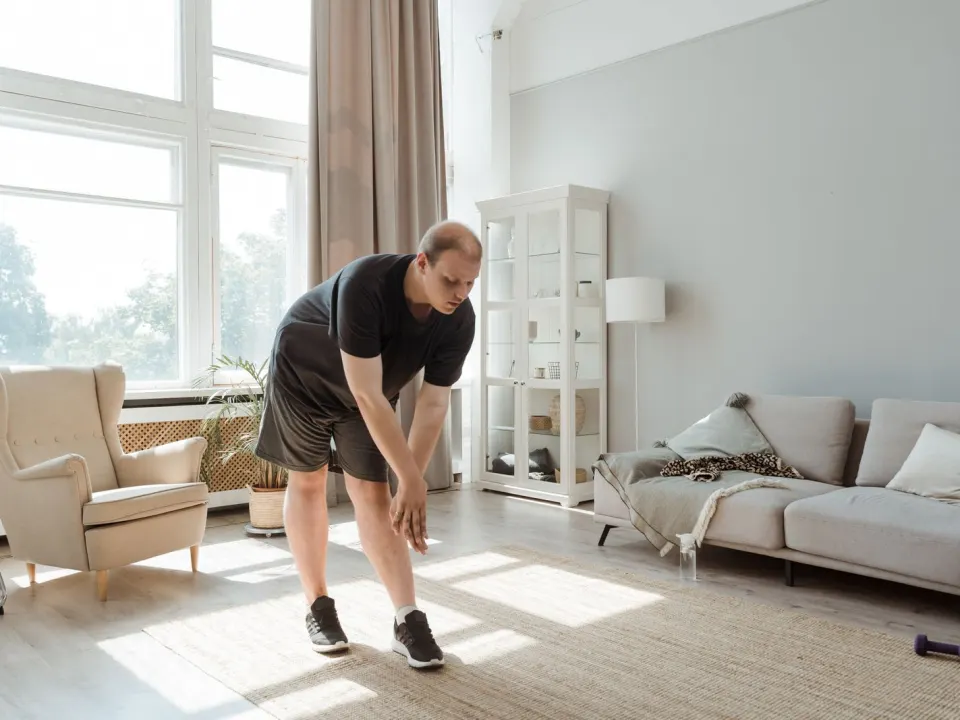
Clear a strip of floor as wide as your sofa. Move drinks, charging cables, and the remote to a side table so you are not stepping over them. A firm sofa is easier for sit-to-stands than a deep, soft one. If the seat swallows you, use a dining chair instead. Leave a clear path so an ad break movement burst does not become a trip.
Wear shoes with a secure sole if the floor is shiny. Socks on a hard floor make marching noisy and slippery. Keep a wall, doorframe, or sofa back within reach. You are not trying to balance on one leg in the dark.
People over 50, or anyone restarting after a long gap, can keep a chair in front as well as behind. Our home workout for beginners over 50 uses the same idea: support first, then less support as the move feels steady.
The 150-second sequence, move by move
When the first advert hits, stand up. Do not wait for a “good” ad. The cue is the cut to commercials, not your mood. Then run this ad break movement circuit once.
- Stand and shake — 15 seconds. Uncross your legs. Plant both feet. Roll the shoulders. Let the arms swing.
- March on the spot — 40 seconds. Lift the knees to a height you can control. Land softly. If a knee objects, shift your weight from heel to toe instead.
- Sit-to-stand — 30 seconds. Sit near the front of the seat. Stand, then lower with control. Aim for four to eight stands. Hands on the cushions are allowed.
- Chest opener — 25 seconds. Place a forearm on a doorframe. Turn the chest away until you feel a gentle stretch. Switch sides. Stay out of a painful pinch.
- Calf raise — 25 seconds. Hold the sofa back. Rise onto the balls of both feet. Pause. Lower for two seconds. Keep it quiet.
- Sit down slowly — 15 seconds. Reach for the seat. Lower without dropping.
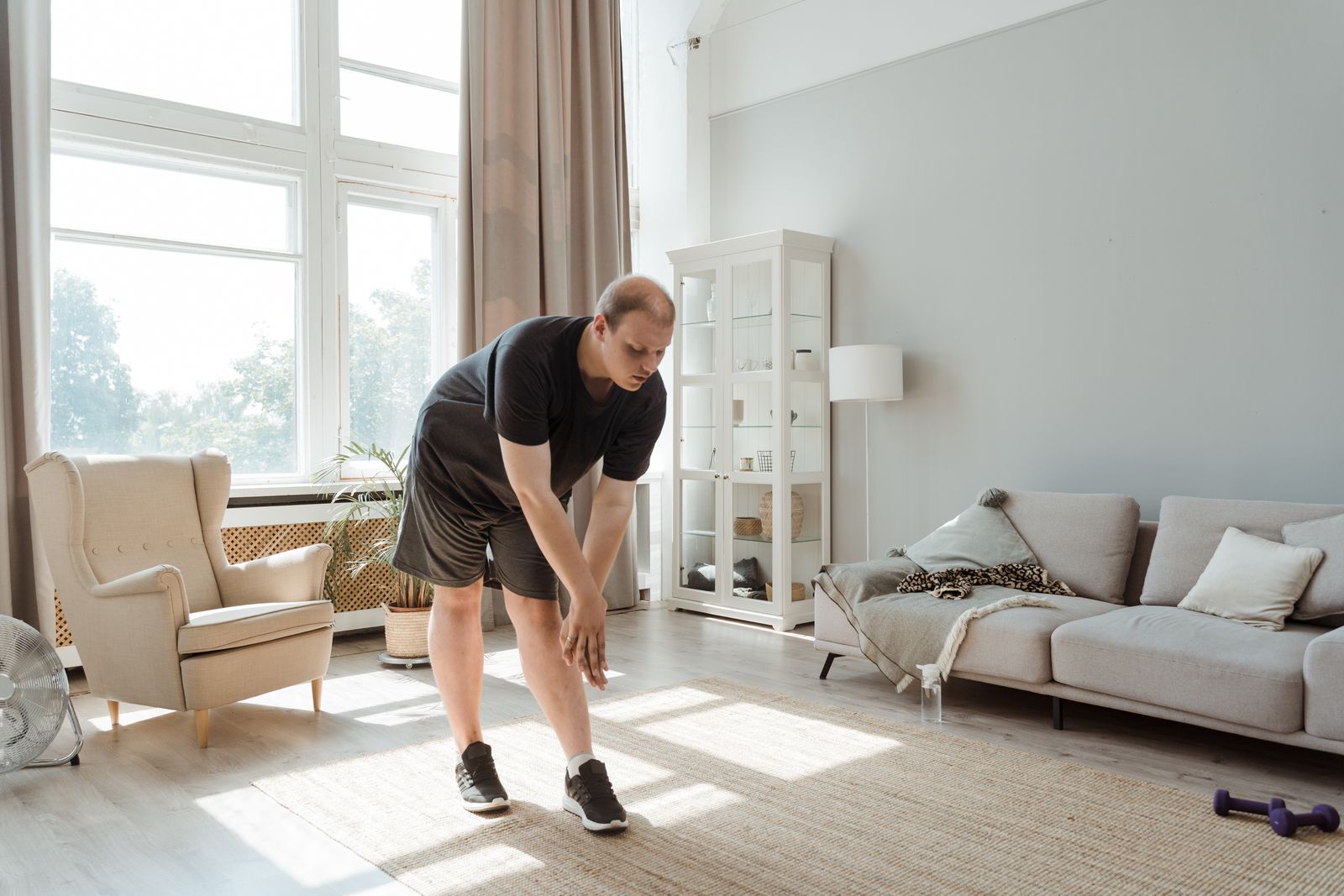
If the break is longer, repeat the march and the sit-to-stands. If it is shorter, keep the stand, the march, and the slow sit. A half-done ad break movement still beats remaining folded into the cushions.
How to keep the habit through a whole episode
One pause is a start. Three pauses in an hour is a pattern. You do not need every break. Choose the first, middle, and last ad pod and ignore the rest if that is all you will do. Consistency beats a heroic first night.
Streaming services sometimes skip ads. In that case, pause the show on purpose every 20 to 30 minutes. The NHS sitting advice is about breaking long stillness, not about commercial television. A kitchen timer works if you watch films.
Keep the effort in the talk-test zone. You should be able to speak a sentence. If you cannot, slow the march. Save harder work for a planned four-week beginner bodyweight plan or a resistance-band full-body session.
Common mistakes and safer swaps
Stand when the ads start. Do not wait to feel ready. Keep most breaks easy so you still stand for the next one. Clear the coffee table rather than lunging over it. Skip a wheeled office chair; it can roll. Use a sofa, dining chair, or wall.
If knees or the lower back complain, reduce depth, hold the sofa, or stay with marching. Sharp or spreading pain is a stop sign. If you live with a heart, lung, or balance condition, ask a GP in the UK or a primary care clinician in the US which moves are suitable. The same applies after recent surgery, during pregnancy, or if you have been told to limit activity.
Ad-break movement menu timed to ~90–150 seconds
- Stand and shoulder rolls × 10 + 10 wall press-ups.
- Sit-to-stand × 8–12 from the sofa edge (firm cushion).
- Calf raises × 12 holding the sofa back.
- Hip hinge reaches × 8 and a 20-second doorway chest stretch each side if time remains.
Streaming without ads
If you stream without ad breaks, pause every two episodes or set a 25-minute soft alarm. The point is a posture change, not perfect exercise science during television.
| Label | Value | Unit |
|---|---|---|
| Stand and shake | 15 | seconds |
| March on the spot | 40 | seconds |
| Sit-to-stand | 30 | seconds |
| Chest opener | 25 | seconds |
| Calf raise | 25 | seconds |
| Slow sit | 15 | seconds |
Evening calm
Keep intensity easy late at night. Save hard HIIT for earlier. Use ad breaks for mobility and circulation so sleep is less likely to be disrupted by a spiked heart rate.
Session notes specific to ad break movement
Before you repeat ad break movement, decide the exact surface, footwear and support object you will use. Write the first set’s intended reps or seconds on paper. After the session, record only what changed: a deeper controlled squat, a quieter footfall, a longer wall-sit, or a press-up incline that felt more stable. Those notes beat vague intentions to ‘train harder’.
If a joint feels sharper during ad break movement than muscularly tired, shrink range or choose the regression described earlier. Home training should leave you able to climb stairs and sleep that night. Seek GP or physiotherapy advice for pain that lingers, swells, or follows a fall.
Space hard versions of ad break movement so similar patterns are not hammered on back-to-back days. A walk, easy mobility, or an upper-body focus can fill the gap while tissues adapt.
Building a three-break evening without fatigue
Break 1 (early episode): stand and march. Break 2: sit-to-stands and shoulder openers. Break 3: calf raises and a longer doorway stretch. Rotating emphasis stops the routine feeling identical and keeps volume modest.
If a show has few breaks, pause once per 25 minutes. Consistency across evenings beats a perfect checklist during a single film.
One more concrete week of practice
Schedule two appointments with yourself for the skills in this article. Session one copies the doses exactly. Session two adjusts a single cue that felt weakest — depth, quiet footfall, hold time, or screen height — and keeps everything else identical.
After those two sessions, keep what was sustainable. Discard any add-on that only worked once. That is enough experimentation for one week.
Coaching details that make ad break movement more repeatable
Treat ad break movement as a skill with measurable standards, not a vague intention to move more. Before the session, name the surface (mat, wall, stair, chair), the exact footwear, and the first prescribed dose from this article — for example a set count, a hold time, or a work/rest interval. If you cannot state the first dose in one sentence, skim the earlier sections again before you start the clock.
During the session, use a simple quality gate: the last two repetitions or the last ten seconds should still resemble the first. When they do not, end the set, rest, and resume with a smaller range, more support, or a slower tempo. That gate protects joints and teaches better motor control than grinding ugly reps to hit a round number.
After ad break movement, write three fields only: what you completed, one cue that helped (soft heel, ribs down, quiet landing, longer exhale), and next-morning joint notes if any. Keep the log in the same notebook or notes thread every time. Over a month, you should see either cleaner technique at the same dose or a small planned progression — more seconds, one extra set, a harder leverage — changed one at a time.
Regression ladder when form or comfort slips
- Shorten range — higher wall-sit, shallower squat, shorter dead-bug reach.
- Add support — chair back, wall fingertips, rail on stairs.
- Slow the tempo — three-second lowers beat bouncing out of the bottom.
- Cut volume — drop a set before you add impact or load.
- Swap the pattern — choose the easier variation already named in this article.
Use the ladder for a full week if needed, then retest the standard version of ad break movement. Regression is training, not failure. People who live in flats, share walls, or train around family schedules especially benefit from quiet, supported options that still load muscle.
Safety boundaries worth repeating
Stop for chest pain, faintness, unusual breathlessness, sudden swelling, or neurological symptoms such as progressive numbness or arm/leg weakness. Sharp joint pain that alters your walk the next day deserves clinical advice rather than another video progression. If you are pregnant, postpartum, post-operative, or living with a long-term condition that affects balance, bone health or heart rate response, ask a GP or physiotherapist (US: primary care clinician or physical therapist) how to adapt the doses here.
Place harder versions of ad break movement on non-consecutive days when the same tissues are the limiting factor. Fill gaps with walking or an upper/lower emphasis that does not repeat the same stress. Consistency across weeks matters more than matching a stranger’s circuit density.
Frequently asked questions
Does standing in the ads count as exercise?
How often should I use ad break movement?
What if I watch programmes without adverts?
Can I do this with sore knees?
Will this replace a proper workout?
Sources
- 1. Benefits of exercise
- 2. Physical activity guidelines for adults aged 19 to 64
- 3. UK Chief Medical Officers' physical activity guidelines
- 4. Adult Activity: An Overview
- 5. Physical activity fact sheet
Guidance changes. Figures were checked against the sources above at the time of review; always confirm current advice with your GP, pharmacist or clinician.
Image credits
- Photo: Photo by Vitaly Gariev on Pexels / Openverse
- Photo: Photo by MART PRODUCTION on Pexels / Openverse
Was this useful?
Anyone can react — no account needed.




Discussion
0 comments · Name and email only · Email is never shown