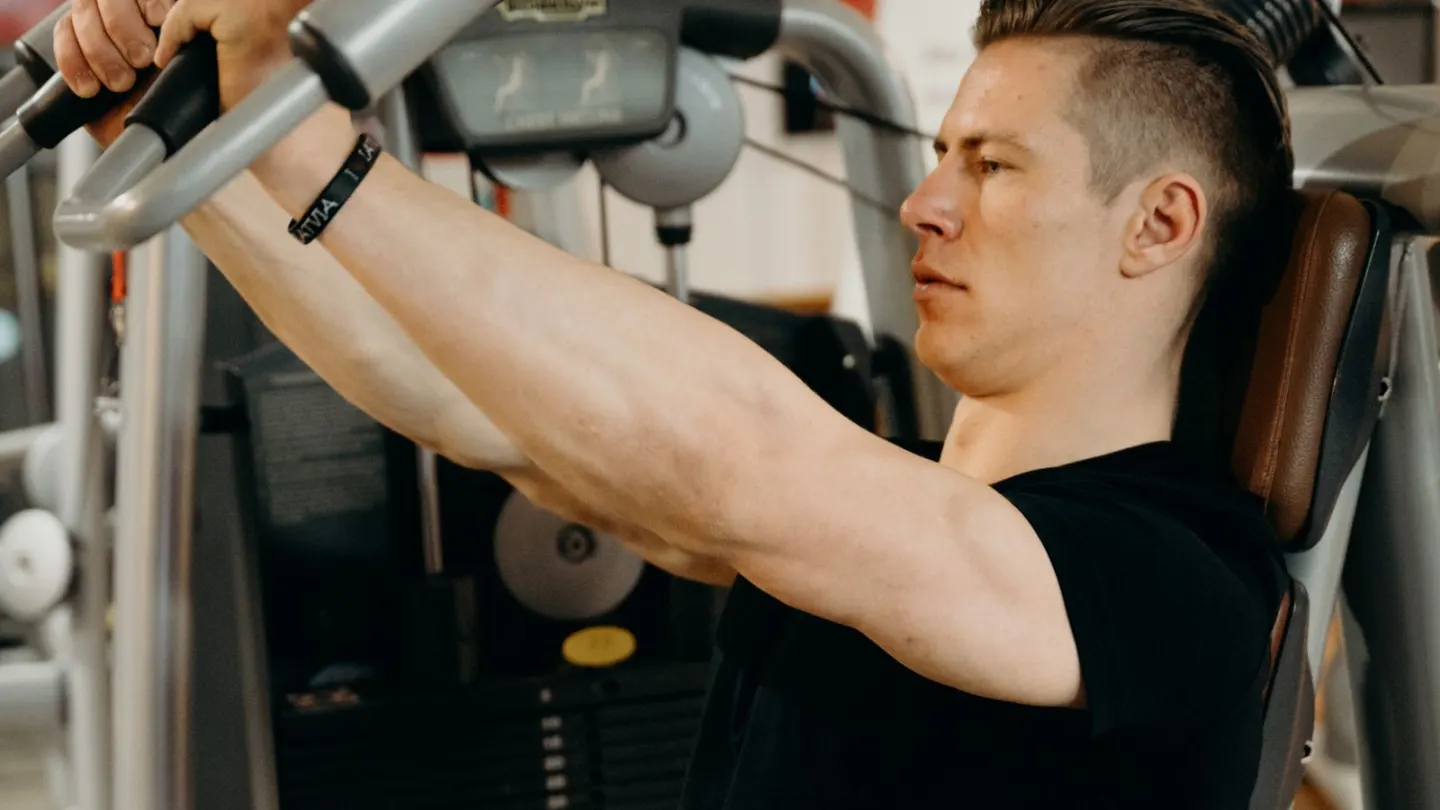
Lat pulldown form is how you pull a bar to the upper chest with a still torso. You sit, you brace, and you let the arms and back do the work. A swing from the hips is extra motion, not extra strength.
The machine looks simple. A bar hangs above you. A pad holds your thighs. You pull. Many people still turn it into a small sit-up. The stack moves. The back gets less of the job. NHS and CDC adult guides still want muscle-strengthening work on at least two days a week. A tidy pull can be the back piece of that week.
This is a how-to for healthy adults in a gym. It is not a diagnosis. It is not a promise of a bigger back. If a shoulder pinches, shorten the range or pick another pull.
What a lat pulldown trains on a gym day
A lat pulldown is a vertical pull. You bring a bar from overhead toward the chest. The large muscles of the back share the work with the arms. The machine supports you, so you can practise the path without hanging from a bar.
It does not replace a row. A row is a horizontal pull. You still want both in a week. The CDC lists back, shoulders and arms among the major groups to train on two or more days. One machine does not tick every box.
NHS pages use the same two-day strength floor, plus at least 150 minutes of moderate aerobic activity. WHO uses a 150 to 300 minute aerobic band. Pair the pull with a squat, a press, and a walk. If you are over 50 or returning after a gap, the strength training over 50 guide is a calmer on-ramp.
How to set lat pulldown form at the seat
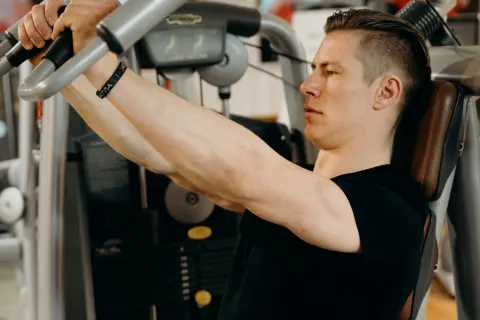
Adjust the thigh pad so you cannot lift off when you pull. Sit tall. Plant both feet. Hold the bar a little wider than the shoulders, palms facing away unless the gym has a parallel handle you prefer. Brace the midriff as if zipping a coat.
Lean back a few degrees, not a full recline. Pull the bar to the upper chest. Think “elbows down and in,” not “yank with the hands.” Pause when the bar is near the collarbones. Lower until the arms are long, without a hard lock that hurts the elbows.
- Set the pad. Thighs stay down. If you rise, the pad is too high or the load is too heavy.
- Choose a grip you can keep. Pain at the wrists often means the hands are too wide or too narrow.
- Pull to the chest, not behind the neck. A behind-neck path can pinch some shoulders. Skip it unless a clinician or coach has cleared that version for you.
- Keep the ribs quiet. A big arch turns the pull into a swing.
- Lower under control. The stack should not crash. ACSM health notes still favour a slow lift and lower, about two seconds each way.
Grip width, torso angle and a full range
Grip is a comfort choice more than a magic trick. A very wide grip often shortens the range. A close grip can feel more like an arm pull. Start near shoulder width plus a hand. Change only if the wrists or shoulders complain.
A small lean lets the bar clear the face. A big lean lets the hips help. If the seat creaks and your hair moves, you are swinging. Sit back down. Take a plate off the stack. Lat pulldown form should look almost boring from the side.
Full range here means long arms at the top and a bar to the chest at the bottom, without pain. You do not need to crush the bar into the sternum. You do not need to stretch so far that the shoulders shrug to the ears. A quiet neck is a useful cue.
Leave two reps in reserve. Our RPE and RIR guide explains that buffer. The last clean rep should feel like work. It should not need a kick from the legs.
A simple twice-weekly pulldown plan
Warm up for five minutes. Walk. Circle the shoulders. Do eight easy band pull-aparts or empty-bar holds if the gym has a light bar. Then rehearse two slow pulldown reps with a light stack. Only then start the working sets.
CDC advice for muscle work is 8 to 12 repetitions per set, with at least one set, and two or three sets for more benefit. ACSM health notes use a similar 8 to 12 band, two or three times a week. Match the effort to a day you could repeat.
| Item | First weeks | Once the pull is smooth |
|---|---|---|
| Sets | 2 | 3 |
| Reps per set | 8 to 10 | 8 to 12 |
| Lowering time | 2 seconds | 3 seconds |
| Rest between sets | 90 seconds | 60 to 120 seconds |
| Days each week | 2, not back to back | 2, still not back to back |
| If it feels light | Add 2 slow reps | Add a small plate, then return to 8 reps |
| If it feels heavy | Stop at 6 clean reps | Reduce the stack or shorten the range |
Place the pulldown after a short walk and before heavy rows if your grip fades. A hybrid strength and cardio week can hold the rest of the minutes. Do not race the stack on the same day you first learn the path.
Write the plate number. When 12 slow reps feel dull, add a small plate and return to eight. That is our progressive overload guide in a small step.
Swinging faults, gym safety and who should adapt
The common miss is a hip snap. The chest shoots up. The bar flies. The stack slams. Sit taller. Think “quiet hips.” If you still need the snap, the load is winning. Take weight off.
Shrugging the bar with the upper traps often means the elbows are flaring too far. Point them toward your ribs on the way down. Neck pain can mean you are jutting the chin. Keep the gaze level, not at the ceiling.
Check cables, clips and the pad before you sit. Our gym safety guide on racks and spotting covers the same habit on free weights. A pulldown is a machine, not a toy. Do not let a child play with the stack. Do not pull from a standing start with a huge lean for a video.
If you have been told to limit overhead work after surgery, wait for personal advice. The same applies if a shoulder clicks with pain, goes numb, or feels weak after a fall. A seated row or a band pull-apart is a fair stand-in.
Stop for chest pain, faintness, unusual breathlessness, or pain that shoots down an arm. Call 999 in the UK or 911 in the US if those symptoms are sudden. Online cues cannot replace an exam.
A twice-weekly pulldown plan with grip notes
Set the thigh pad snug. Reach up so you are not jumping to the bar. Pull to the upper chest with a slight lean, elbows driving down. Example: lat pulldown 4×8–12 at RPE 8 twice weekly, paired with a row 3×8–12 and a face-pull 2×15.
Medium grip slightly outside shoulders is a sensible default. Very wide grips often shorten range; very narrow grips shift demands — pick one for a block.
Control the return until elbows are long without violently shrugging into the neck.
| Week | Prescription | Advance when |
|---|---|---|
| 1–2 | 3 × 10 | All reps clean |
| 3–4 | 4 × 10 | RPE ≤8 |
| 5–6 | 4 × 8 heavier | Form holds |
| Deload | 2 × 10 light | After hard block |
Swinging faults and safety
Leaning back into a row every rep turns the stack into momentum theatre — keep the lean slight and consistent.
Pulling behind the neck is unnecessary for most people and can irritate shoulders; prefer front pulldowns.
Releasing the bar to crash the stack risks plates and cables — keep a hand on the handle until it is set down.
Linking pulldowns to pull-up goals
Use pulldowns for volume while pull-up practice stays skill-focused: hangs, scap pulls, assisted reps.
Every fortnight, test assisted pull-up band colour or foot assistance height to ensure transfer.
Do not let pulldown ego loads ruin the elbow path you need on the bar.
Who should adapt pulldowns
People with shoulder pain may try neutral-grip handles and shorter range; persistent pain needs clinical assessment.
Those chasing pull-ups can use pulldowns as volume while they build hangs and assisted reps.
If thigh pads are missing and you lift off the seat, reduce load until you stay seated.
Coaching cues and checkpoints for lat pulldown form
Return to the key prescriptions for lat pulldown form already set out above and execute them as written for two consecutive sessions before you invent variations.
Use the checkpoints below as a quick pre-set scan for lat pulldown form. If any line fails, fix that line before you add load, speed or volume.
- 1–2: 3 × 10 — All reps clean
- 3–4: 4 × 10 — RPE ≤8
- 5–6: 4 × 8 heavier — Form holds
- Deload: 2 × 10 light — After hard block
After those two honest sessions, change only one variable in lat pulldown form: a small load jump, one extra repeat, a slightly longer interval, or one fewer accessory set. Write the change in the log before you warm up.
Stop for sharp pain, chest pain, faintness or unusual breathlessness. Call 999 or 911 for sudden severe symptoms. This article is general information, not a diagnosis or a personalised rehab plan.
Frequently asked questions
Should I pull the bar behind my neck?
Wide grip or close grip for lat pulldown form?
How heavy should the stack be?
Can I do pulldowns every day?
What if I cannot do a pull-up yet?
Sources
- 1. Physical activity guidelines for adults aged 19 to 64
- 2. Strength exercises
- 3. Adult Activity: An Overview
- 4. What Counts as Physical Activity for Adults
- 5. Physical activity fact sheet
- 6. Physical Activity Guidelines
- 7. Resistance Training for Health
- 8. Why you should do strength training
Guidance changes. Figures were checked against the sources above at the time of review; always confirm current advice with your GP, pharmacist or clinician.
Image credits
- Photo: Photo by Alesia Kozik on Pexels / Openverse
- Photo: Photo by Santeri Viinamäki / Wikimedia Commons / Openverse
- Photo: Photo on Pexels / Openverse
Was this useful?
Anyone can react — no account needed.


Discussion
0 comments · Name and email only · Email is never shown