Health Data Science explainer
Mood Tracking Evidence: Useful Patterns or Too Much Self-Monitoring?
Updated

Mood tracking evidence sits between two stories. One says a daily score makes patterns visible. The other says staring at a low number can feed rumination. Both can be true. This is a source-reviewed guide, not a hands-on lab test.
What mood tracking evidence is trying to answer
A mood app asks you to name a feeling, often more than once a day. Researchers like that because memory is biased. Monday’s crash fades by Friday’s clinic visit. EMA and daily diaries catch the in-between. The question for shoppers is different: does the act of scoring yourself improve how you feel, or only how you report?
Those are not the same outcome. A more accurate chart can still leave symptoms unchanged. A slightly better score can still come from extra contact, not from the chart. Mood tracking evidence is strongest when papers keep those layers apart.
When a log is a research tool, not a therapy
EMA studies often ping people many times a day. Hijne, Wiers, Smits and colleagues (2021, Behaviour Research and Therapy) asked 97 adults to rate affect and rumination ten times a day for six days. Worse negative affect, and lower positive affect, predicted more rumination at the next ping. People who already described their negative thinking as automatic showed a tighter link. The paper is about habit-like rumination, not about Daylio. The practical warning is simple. If your mind already loops, a prompt can start the loop.
That does not mean every log is harmful. It means “more data” is not a free lunch. If you already replay the worst hour, a 2 p.m. ping can become another rehearsal.

What happened when monitoring was the intervention
Faurholt-Jepsen and colleagues ran MONARCA I, published in 2015. Seventy-eight adults with bipolar disorder used a smartphone for six months. One arm did daily self-monitoring with a clinical feedback loop. The other used the phone as a normal phone. Intention-to-treat models found no significant effect on Hamilton depression or Young mania scores. There was a tendency toward more sustained depressive symptoms in the monitoring group. A subgroup without mixed states showed more depression and fewer manic symptoms while monitored.
The authors’ line is the right one: electronic self-monitoring is appealing and still needs caution before it becomes a clinical default. Mood tracking evidence from that trial is not a green light for every wellness chart.
Dubad, Elahi and Winsper’s MeMO study (2021) used a public mood app with young people already in mental-health services. Mixed methods, mixed numbers. Momentary positive mood did not clearly rise across all ratings. Some engagement and qualitative comments were warmer. The authors treated prior “apps help mood” claims as limited. That is the honest register.
When a text or a skill sits beside the score
Figueroa, Aguilera and colleagues have tested CBT-style text programmes that include a daily mood check. A 2025 npj Mental Health Research paper on personalising texts noted that a mood-monitoring-only arm also saw symptom scores fall. The authors listed possible reasons: the check-in itself, extra contact, or regression to the mean. They asked for trials that compare monitoring with no message at all. That sentence is the gap. Mood tracking evidence still lacks a clean “chart versus silence” answer for everyday depression apps.
Kinderman’s older Catch It work asked people to rate mood, reappraise, then rate again. Later MeMO use of a similar idea did not copy the same lift. Techniques that look like CBT homework are not guaranteed by a pastel interface.
| Question / claim | Source (year) | Study type | Population | Comparator | Outcome | Key finding | Limitation | Applicability |
|---|---|---|---|---|---|---|---|---|
| Does daily phone monitoring cut bipolar symptoms? | Faurholt-Jepsen et al., MONARCA I (2015) | RCT, 6 months | 78 adults with bipolar disorder (ICD-10); HAMD and YMRS ≤17 at entry | Smartphone without the monitoring package | HAMD-17; YMRS | No significant benefit. Trend toward more depressive symptoms with monitoring | Single-blind; one clinic pathway; older software | Do not assume a mood log treats bipolar disorder |
| Does a public mood app help youth in care? | Dubad et al., MeMO (2021) | Mixed methods | Young people with mental-health problems using a public app | Within-person and qualitative | Momentary and retrospective affect; engagement | Mixed; no clear rise in positive mood across all ratings | Small, selected sample; public app, not a sealed protocol | A download is not a youth treatment plan |
| Does a low mood trigger rumination in daily life? | Hijne et al., Behav Res Ther (2021) | EMA, 6 days | 97 adults | Within-person lags | Affect; rumination | Worse affect predicted later rumination, more so when negative thinking was habitual | Short window; not a treatment trial | If you ruminate, a ping can become fuel |
| Is a mood text enough to move symptoms? | Figueroa et al., npj Ment Health Res (2025) | Personalised texting trial discussion | Adults in a CBT-text programme | Arms that added tips vs mood check only | Symptom scores over time | Monitoring-only arm also improved; authors called for a no-message control | Not a pure “app store journal” study | Contact and time may explain part of the lift |
| What should people do if mood stays low? | NHS mental health; NIMH; WHO fact sheet | Public guidance | General public | Not a trial | Care pathways | Seek professional help when symptoms persist or risk rises | Not app-specific | A tracker is optional. Care is not |
Accuracy: what a tap can and cannot see
A three-face scale is easy. It is also coarse. It misses mixed states, numbness, and the hour you felt fine in a shop then crashed at home. Tags help a little. They still depend on you noticing the right cue. Mood tracking evidence on “accuracy” is really evidence on reliability of self-report, not a blood test.
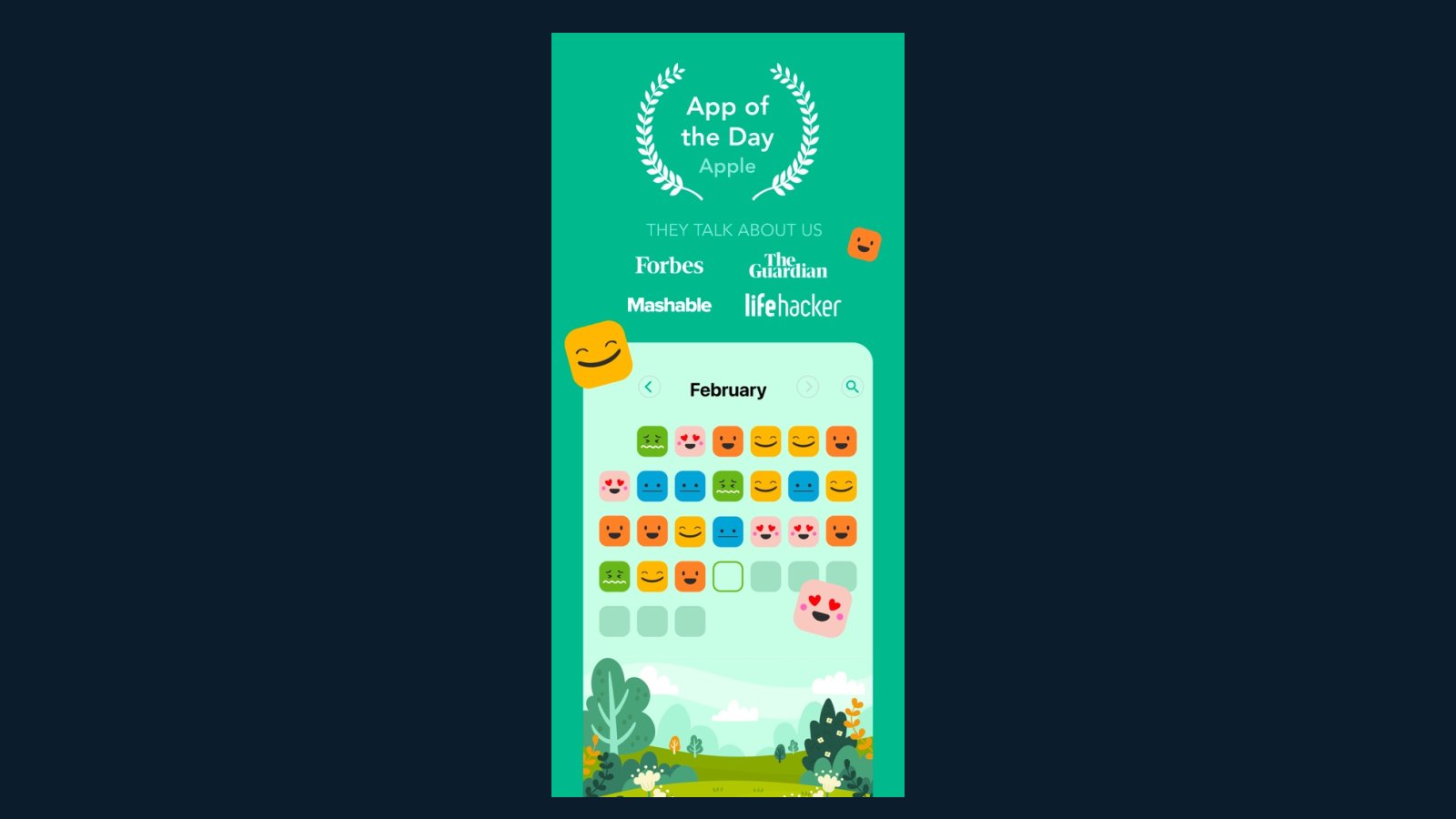
Sharing a chart with a clinician can still be useful. Bring three weeks, not three years. Name sleep, alcohol, missed doses and conflict. The Daylio review and Stoic review describe two consumer logs. Neither is a validated diagnostic instrument.
When self-monitoring becomes too much
Stop or thin the log if you open it to punish yourself. Stop if you skip plans because the score is “bad.” Stop if you check it more than you live the day. Those are practical brakes, not a diagnosis of “orthorexia of feelings.”
People with obsessive checking, severe depression, or eating-pattern secrecy may do worse with a dense diary. That is a reason to ask a clinician, not to download a second app. Habit skins such as the Finch review or the Fabulous review still collect mood. A pet does not make the score safer.

How to run a two-week test without a story
Week one: one rating a day, same time, plus three words. No colours beyond a simple scale. Week two: add one tag for sleep or people. If the chart helps you ask a better GP question, keep it. If it feeds a loop, delete it. Pair movement with mood only if it feels kind. See exercise for mental wellbeing. If food is the evening valve, use the stress eating practical guide.
The category page is best habit tracking apps. It is a shopping map. It is not mood tracking evidence.
What public agencies still emphasise
NHS mental-health pages describe self-help and when to see a GP. NIMH describes therapies and medicines as clinical tools. WHO’s mental-health fact sheet still centres people, community and services. None of those pages crown a commercial tracker. NICE looks at some digital programmes as technologies, not as every pastel journal.
If you are unsafe, use local emergency routes. In the UK that is 999 or NHS 111. In the US that is 911 or 988. An app badge is not an emergency service.
Frequently asked questions
Does mood tracking work?
Can mood tracking make me feel worse?
How often should I rate my mood?
Is a mood app accurate?
Can a mood app replace therapy?
Sources
- 1. Daily electronic self-monitoring in bipolar disorder — MONARCA I
- 2. The clinical impacts of mobile mood-monitoring in young people: the MeMO study
- 3. Do daily mood fluctuations activate ruminative thoughts as a mental habit?
- 4. Personalizing a mental health texting intervention using reinforcement learning
- 5. Mental health
- 6. Mental health information
Guidance changes. Figures were checked against the sources above at the time of review; always confirm current advice with your GP, pharmacist or clinician.
Image credits
- Photo: Photo by Anna Shvets on Pexels / Openverse
- Photo: Photo by Christina Morillo on Pexels / Openverse
- Photo: Photo by fauxels on Pexels / Openverse
- Photo: Photo by Andrea Piacquadio on Pexels / Openverse
- Photo: Photo by Pixabay on Pexels / Openverse
Was this useful?
Anyone can react — no account needed.


Discussion
0 comments · Name and email only · Email is never shown