This page answers a narrow question: what hydration app water target evidence actually supports. This is a source-reviewed guide, not a hands-on lab test. Apps can log glasses. They cannot see your plasma osmolality. Official water figures come from NHS, EFSA, the US National Academies, and named reviews, captured or cited on 13 September 2026.
What hydration app water target evidence actually asks
Hydration app water target evidence is not a taste test of WaterMinder or Waterllama. It is a check on the number those apps put at the top of the day. Many products start from a round goal. Some let you type a custom millilitre figure. The science question is whether any single default fits a worldwide adult.
It does not. Official pages disagree on the unit, the sex split, and whether food counts. That is the first thing an honest app should show. For product shopping, use the hydration apps and nutrition products hub. This page stays on the target.
What official pages recommend
NHS live-well copy says most people should drink enough that urine is a clear pale yellow. The Eatwell Guide tells people to aim for 6 to 8 cups or glasses of fluid a day. Water, lower-fat milk, and sugar-free drinks including tea and coffee count. You may need more in heat, during activity, or when unwell. The British Nutrition Foundation restates 6 to 8 glasses and notes that UK government arithmetic is about 1.2 L from drinks if you use small glasses (six 200 ml or eight 150 ml).
EFSA’s 2010 Scientific Opinion on dietary reference values for water set adequate intakes of 2.0 L a day for adult women and 2.5 L for adult men as total water. EFSA assumed roughly 20% from food and 80% from drinks in a temperate climate with moderate activity. The British Dietetic Association translates drink-only water as about 1.6 L for women and 2.0 L for men, with extra in pregnancy and lactation.
The US Institute of Medicine, now the National Academies, set adequate intakes in 2004 from median survey intakes: 2.7 L total water for young women and 3.7 L for young men. Fluids supplied about 2.2 L and 3.0 L in that dataset. Those are adequate intakes, not a line you fail if you drink less on a cool rest day. The report said people can be well hydrated over a wide range.
| Question or claim | Source | Type | Population | Finding | Limitation | App meaning |
|---|---|---|---|---|---|---|
| 6–8 glasses a day | NHS; UK Eatwell Guide | Public health advice | General UK public | Aim for 6–8 cups or glasses; pale-yellow urine; more in heat or sport | Glass size is not fixed; food also counts | A 2 L lock may be higher than this drinks-only guide |
| 2.0 L women / 2.5 L men total water | EFSA 2010 DRV | Adequate intake | Adults, temperate climate, moderate activity | Total water includes food (~20%) and drinks (~80%) | Not a trial of app reminders | If an app ignores food, it overstates the drink goal |
| 2.7 L women / 3.7 L men total water | IOM / National Academies 2004 | Adequate intake from US medians | US survey adults | Set from observed intakes, not from a disease-prevention trial | US food patterns and climate differ from the UK | Importing the US AI as a UK app default is a mismatch |
| Everyone needs 8 × 8 oz of water | Valtin 2002; Negoianu & Goldfarb 2008 | Narrative evidence reviews | Healthy adults in the cited literature | No clear benefit from forcing extra water in healthy people | Not new RCTs; older papers | An 8-glass trophy is folklore, not a standard |
| Plain water intake in the US | CDC water-consumption facts | Surveillance | US children and adults, 2015–2018 | Adults averaged about 44 oz of plain water a day | Plain water is not total fluid | A 64 oz app goal can sit above what many people already drink as water |
Why eight glasses is a weak app default
Heinz Valtin’s 2002 review hunted for the origin of “8 × 8.” He found no rigorous proof that healthy, sedentary adults must drink 64 US fluid ounces (about 1.9 L) of water on top of food. He noted that tea, coffee and other drinks count for most people. Negoianu and Goldfarb, writing in the Journal of the American Society of Nephrology in 2008, reached a similar line: there is no clear evidence of benefit from forcing extra water in people who are already well.
The story likely grew from a 1945 Food and Nutrition Board remark of about 1 ml of water per kilocalorie, without stressing that food already supplies a large share. An app that copies “8 glasses” without saying 8 × what, and without counting soup or fruit, repeats that old slip.
CDC pages say enough water matters and that dehydration can affect thinking, mood, temperature control, constipation and kidney-stone risk. They do not issue a single universal glass count for every adult. That honesty should be the app’s tone too.
What an app can know — and what it cannot
A phone can count taps. It can store a number you typed. It cannot measure sweat, sodium loss, or kidney concentrating ability. Body-weight formulas and “divide your pounds by two” tricks are not official DRVs. We omit any app-specific millilitre default we did not see on a dated store listing.
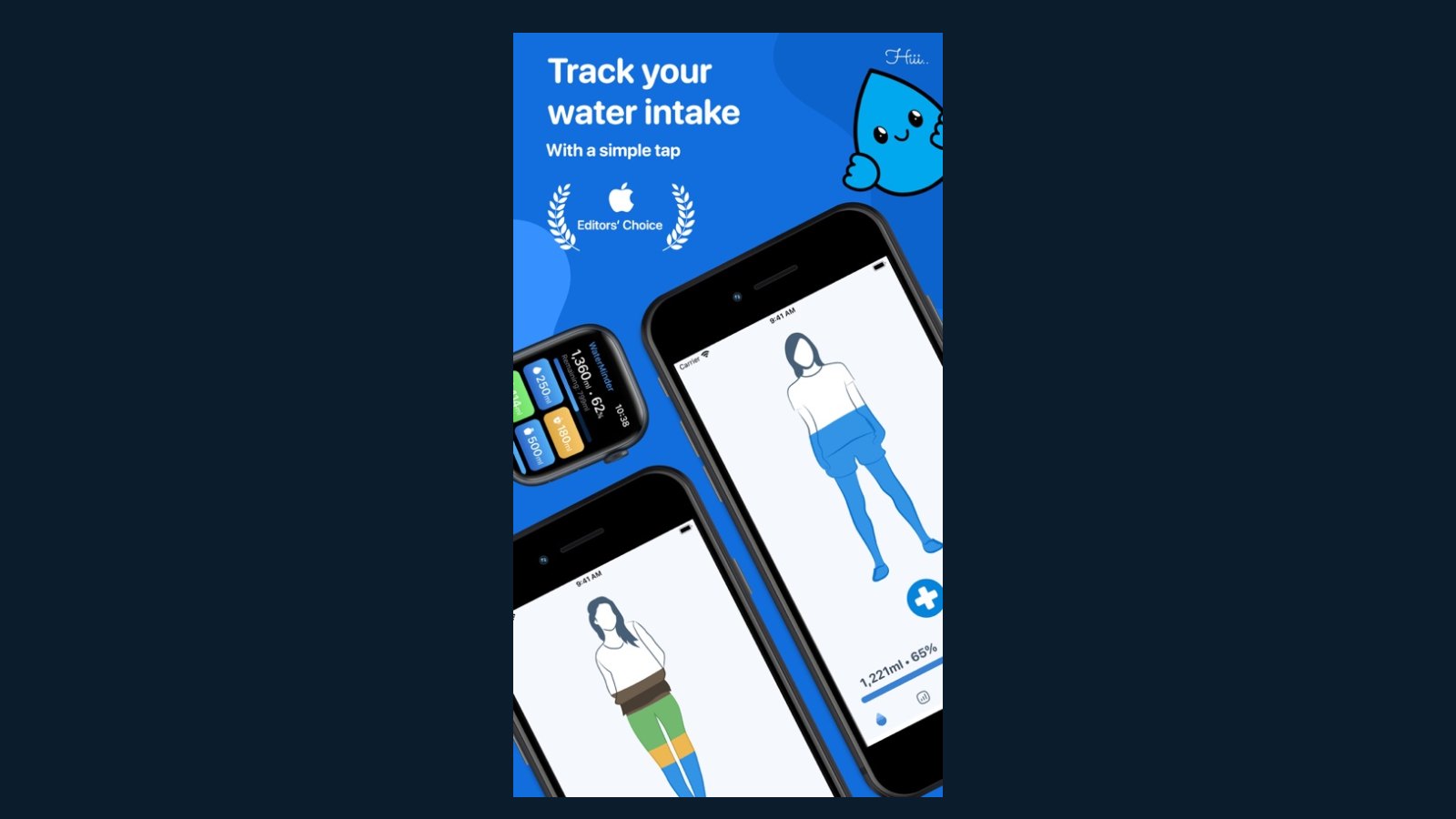
If you use Plant Nanny, WaterMinder, or Waterllama, look at three settings. Does the goal include tea and milk? Does it include food water? Can you lower the goal on a rest day? If the answer is no, you are using a sticker, not a model.
Weather widgets and watch heart-rate fields do not turn the app into a lab. They can nudge you to drink in a heatwave. They cannot tell you that you already ate a watery stew.
When you may need more — or less
Need rises in heat, dry air-con, endurance sessions, fever, vomiting, and diarrhoea. NHS pages say drink extra then, and prefer water. BDA notes pregnancy and lactation add hundreds of millilitres to the drink target. Those are clinical adjustments, not unlockable app badges.
Need can fall, or become risky, if you have heart, kidney or liver disease and your clinician has set a fluid limit. An app that shames you for missing 3 L can be harmful in that setting. Turn the goal down or delete the streak.
Older adults often feel thirst later. BNF and BDA flag that group for regular drinks, not for a bigger trophy. Cochrane reviewers have also warned that urine colour and volume alone are weak tests of dehydration in older people. Pale urine is still a useful everyday clue for healthy adults. It is not a diagnosis.
Endurance athletes can drink too much. Hyponatraemia from excess water is a documented race-day hazard. “Sip to thirst” during long events is a sports-medicine conversation, not an app’s 15-minute nag.
Food, protein shakes and other liquids still count
EFSA and BDA both keep food in the water budget. Fruit, vegetables, yoghurt, stews and cooked grains are not “cheating.” An app that only ticks tap water will under-count a high-plant day and over-nag a soup day.
Milk, tea and coffee count toward NHS fluid. Energy drinks and juice add sugar. That is a diet issue, not a hydration bonus. A 400 kcal complete-food shake such as Huel Black Edition is mostly water by weight once mixed, plus protein. It is a meal, not a reason to raise the app’s water trophy. Protein still comes from food patterns described in our everyday protein guide.
Where the evidence is thin
We did not find a large randomised trial that proves a smartphone water target improves hard outcomes such as kidney-stone recurrence or heat illness in general adults. Reminder apps may raise logged intake. Logged intake is not the same as better health.
We also did not verify each brand’s current default millilitres. Those screens change. If an app cites “science-backed 3 L,” ask which committee and whether food is included. If the citation is missing, treat the number as a design choice.
Hydration app water target evidence, in one line: official ranges exist, they disagree, and none of them were written as a push notification.
Frequently asked questions
Should my hydration app set 2 litres for everyone?
Do tea and coffee count?
Is pale-yellow urine a good target?
Can drinking extra water help me lose weight?
When should I ignore the app and call a clinician?
Which hydration app has the most accurate target?
Sources
- 1. Water, drinks and hydration
- 2. Hydration information
- 3. Fluid (water and drinks)
- 4. Dietary Reference Intakes for Water, Potassium, Sodium, Chloride, and Sulfate
- 5. Drink at least eight glasses of water a day. Really?
- 6. Fast facts: data on water consumption
Guidance changes. Figures were checked against the sources above at the time of review; always confirm current advice with your GP, pharmacist or clinician.
Image credits
- Photo: Photo by Pixabay on Pexels / Openverse
- Photo: Photo by T.Tseng on Wikimedia Commons / Openverse
- Photo: Photo by Jon Sullivan on Wikimedia Commons / Openverse
Was this useful?
Anyone can react — no account needed.
Discussion
0 comments · Name and email only · Email is never shown